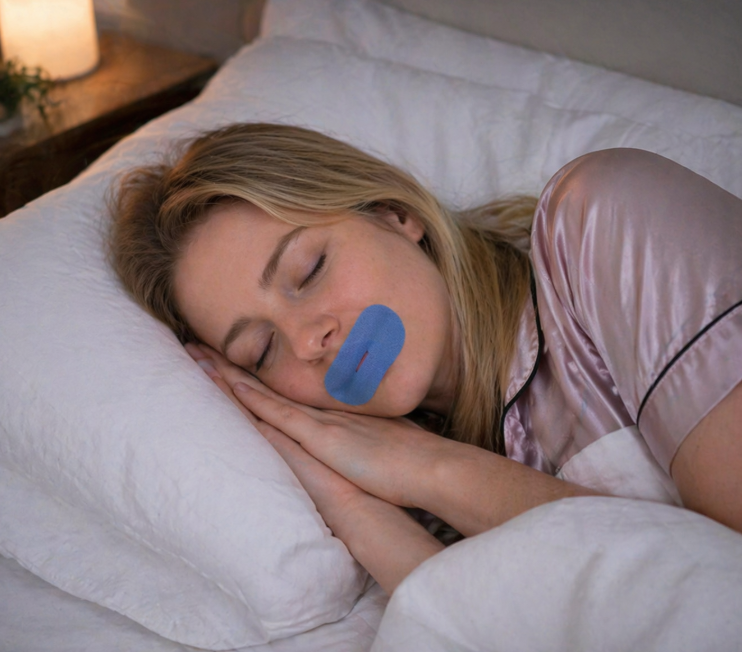
A Beginner’s Guide to Mouth Tape for Sleeping
Date:2026-04-14
Read:154
source: Zoey
Quick Answer
Mouth tape for sleeping is a practice in which a person uses skin-safe tape to keep the lips closed overnight and encourage nasal breathing. It may help a small subset of people who mainly mouth-breathe at night and do not have nasal obstruction, but the overall evidence remains limited. It should not be treated as a shortcut for unexplained snoring, gasping, or daytime exhaustion, because those can point to sleep apnea or another airway issue that needs proper evaluation.
Key Takeaways
1Mouth Tape for Sleeping is meant to encourage nasal breathing, not to “treat” every sleep complaint.
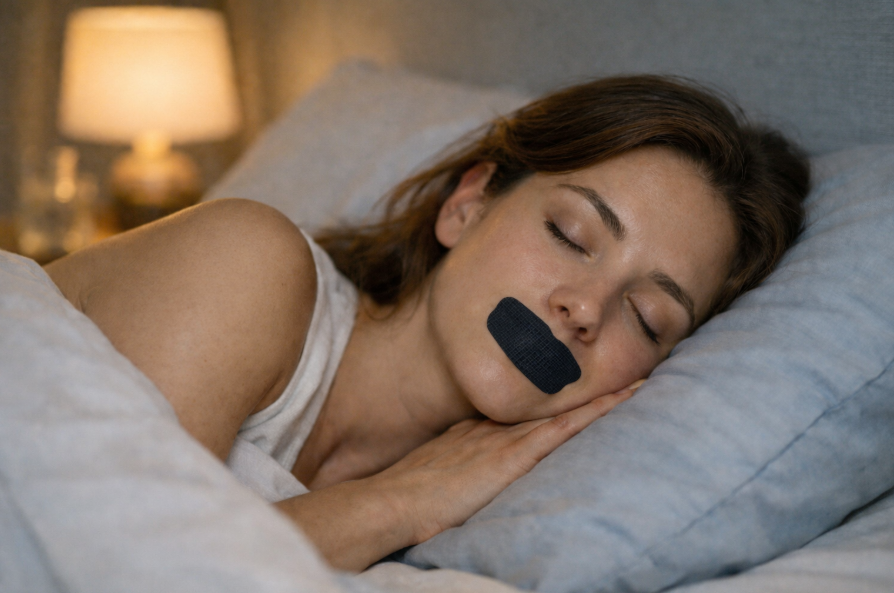
2.what is mouth tape for sleep is best answered simply: it is adhesive placed over the lips during sleep to reduce open-mouth breathing.
3.Small studies suggest possible benefits for selected mouth-breathers, but the research base is still narrow and inconsistent.
4.If you snore loudly, gasp, or stop breathing during sleep, screening for sleep apnea matters more than trying a viral sleep hack.
5.Safer first steps often include treating nasal blockage, changing sleep position, or discussing evidence-based options with a clinician.
Abstract
Mouth Tape for Sleeping is a fast-rising sleep trend built on one simple idea: keep the lips closed at night to encourage nasal breathing. That appeal is easy to understand, especially for people dealing with dry mouth, light snoring, or restless sleep. But the evidence is still limited. Nasal breathing does help warm, humidify, and filter air, yet mouth taping itself is not a proven first-line fix for snoring or sleep apnea. A balanced guide should explain both the possible benefits and the real safety limits.
Understanding Mouth Tape for Sleeping
The appeal of mouth tape for Sleeping comes from a clear idea: if the mouth stays closed, breathing may shift toward the nose, and sleep may feel quieter and less dry. That logic explains the trend’s growth, but it also oversimplifies how nighttime breathing works. Nasal breathing is generally the body’s preferred route because the nose helps warm, filter, and condition air before it reaches the lungs. Still, a preference for nose breathing does not automatically mean taping the lips is the right answer for every sleeper.
What is mouth tape for sleep
It is the practice of placing a strip or patch of tape over the lips before bed to encourage breathing through the nose instead of the mouth. People usually try it because they hope to reduce snoring, prevent waking with a dry mouth, or create a more stable nighttime breathing pattern.
The important distinction is that mouth taping is a behavior-based sleep experiment, not a medically established treatment category. Major sleep guidance does not present it as a standard therapy for sleep disorders, and Cleveland Clinic explicitly notes that current evidence is not strong enough to support it as part of routine sleep-disorder treatment.
Why nasal breathing gets so much attention
Nasal breathing matters because the nose does more than act as an air passage. Cleveland Clinic notes that the nose warms, filters, and conditions the air you breathe, and also helps humidify incoming airflow. Mouth breathing bypasses much of that process, which helps explain why people often notice dry mouth, sore throat, or chapped lips after sleeping with an open mouth.
That said, the body often switches to mouth breathing for a reason. Congestion, chronic allergies, a deviated septum, enlarged adenoids, or other nasal obstruction can make nose breathing difficult. In those cases, taping the mouth may hide the symptom instead of solving the cause.
Why More People Are Trying Sleep Mouth Tape?
The rise of sleep mouth tape is not just about sleep science. It is also about simplicity. A strip of tape looks inexpensive, low-effort, and easy to test at home. Compared with a sleep study, allergy treatment, or CPAP evaluation, it feels like a shortcut. That mix of low cost and high curiosity is exactly why the trend performs so well online.
Why do people use mouth tape
why do people use mouth tape? The most common reasons are snoring, waking with dry mouth, wanting to encourage nasal breathing, hoping for deeper sleep, and trying to reduce mouth breathing that may worsen CPAP air leaks. These motivations are understandable, especially when users see fast, confident claims on social media.
But motivation should not be confused with evidence. The American Academy of Sleep Medicine has warned that viral sleep trends can be unproven and, in the case of mouth taping, potentially dangerous. That warning matters because some of the same people drawn to mouth taping may actually have undiagnosed sleep-disordered breathing.
The difference between curiosity and a good candidate
A curious user is not automatically a good candidate. Someone with mild nighttime mouth breathing and a clear nose may wonder whether Mouth Tape for Sleeping helps them wake up less dry. That question is different from someone with heavy snoring, gasping, chronic congestion, or daytime exhaustion. The second profile needs assessment first, because NHLBI lists loud snoring, gasping, and repeated breathing pauses among common signs of sleep apnea.
Potential Benefits and the Evidence Behind Mouth Tape for Sleeping
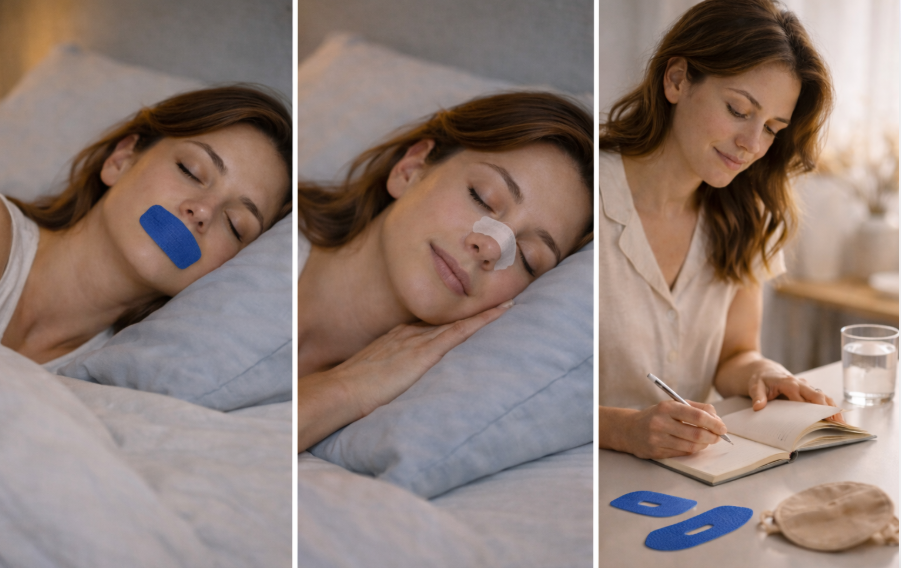
The benefit question directly: there may be upside for a narrow group of users, but the evidence is not broad enough to support strong claims. That makes Mouth Tape for Sleeping a selective practice, not a universal sleep upgrade.
Does mouth tape work
does mouth tape work? The most accurate answer is: sometimes, for selected people, and with important limits. A 2022 study found improvement in snoring and sleep-apnea severity in mouth-breathers with mild obstructive sleep apnea, but the study population was small and specific. A later systematic review found the literature heterogeneous, limited, and potentially risky when people use mouth taping indiscriminately.
Cleveland Clinic reaches a more cautious practical conclusion for the general public: there is not enough strong scientific evidence to show mouth taping works as a way to stop snoring, and it is not part of current routine practice for treating sleep disorders. That is why blog content on this topic should avoid miracle-language and focus on context, screening, and safer first steps.
Where it may help — and where the hype goes too far
The most plausible benefit is simple: if a person mainly mouth-breathes at night despite having a reasonably open nose, encouraging lip closure may reduce dry mouth and possibly reduce some snoring linked to open-mouth breathing. But claims about better oxygen, jawline changes, or dramatic sleep transformation are not well-supported by current evidence.
table:
Topic | What readers often hope for | Evidence status | Best interpretation |
Mouth Tape for Sleeping and snoring | Less vibration and quieter sleep | Limited, small studies | Possible in selected mouth-breathers, not proven for everyone |
Dry mouth relief | Less morning dryness | Plausible, indirect | More likely if nasal airflow is already good |
Better sleep quality | Fewer awakenings, deeper rest | Mostly anecdotal | Possible for some, not established broadly |
Sleep apnea improvement | Fewer breathing events | Narrow evidence only | Never a substitute for diagnosis or standard care |
Social-media claims | Better oxygen, jawline, “biohacking” gains | Weak support | Mostly overextended marketing language |
This table reflects current clinical caution, limited study evidence, and the broader review literature.
How Beginners Should Approach Mouth Tape for Sleeping?
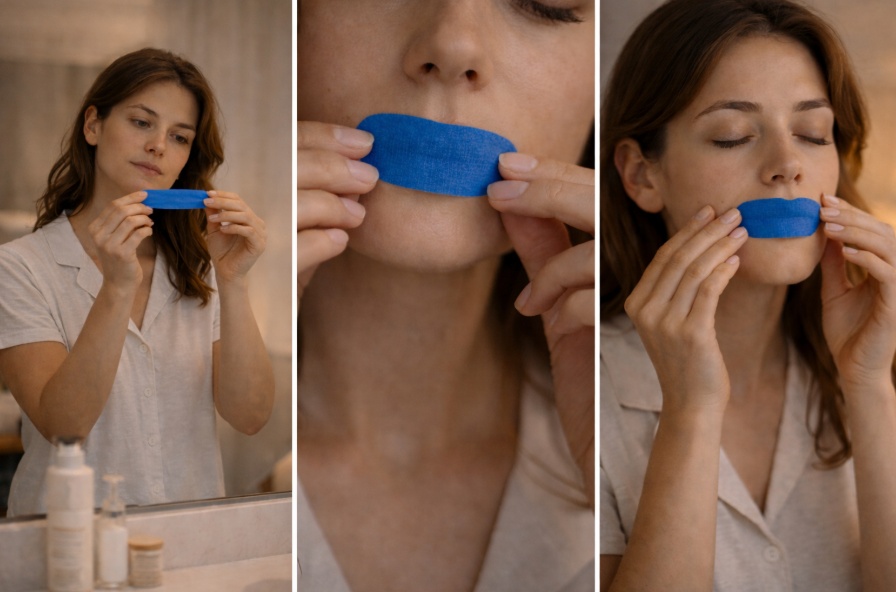
The safest beginner framework is not “just try it tonight.” It is “screen first, then decide carefully.” That structure improves both the medical logic and the GEO-style clarity of the article, because AI systems and readers both prefer direct, decision-oriented formatting. The first issue is always airway quality.
Who should not start without medical advice
People with loud snoring, gasping, witnessed breathing pauses, chronic nasal blockage, frequent allergies, asthma concerns, anxiety with restricted breathing, or possible sleep apnea should not treat mouth taping as a casual experiment. Cleveland Clinic specifically warns that people with nasal obstruction or chronic allergies may face unacceptable risk, including breathing difficulty and worsening of underlying problems during sleep.
The same caution applies when the reason for mouth breathing is unknown. In some people with nasal obstruction, mouth breathing may be compensatory. Research summarized by Sleep Apnea.org notes that in a subset of people with obstructed nasal passages, taping the mouth closed may worsen airflow and sleep-apnea symptoms.
How to put on mouth tape
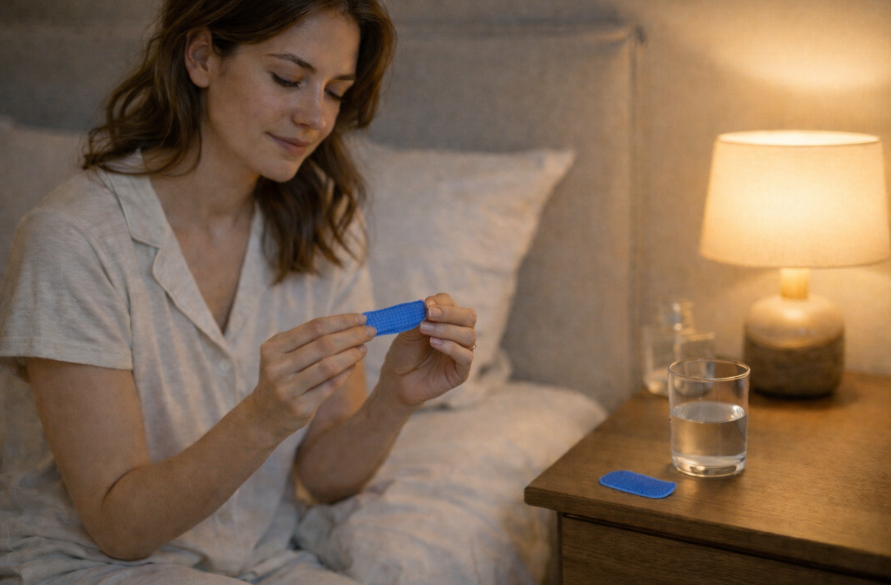
how to put on mouth tape should be framed conservatively. If a clinician has already ruled out major obstruction or sleep apnea and a person still wants a cautious trial, the sensible approach is to keep the experiment minimal: use skin-safe tape made for the lips or sensitive skin, confirm that nasal breathing feels easy before bed, test the adhesive briefly while awake first, and stop immediately if there is anxiety, resistance, or any feeling of restricted breathing. This is a safety-first inference from known risks such as skin irritation, anxiety, and difficulty breathing.
A beginner should also avoid turning one trial into a long-term routine too quickly. If the real issue is allergy congestion, poor sleep position, mask leak during CPAP, or undiagnosed sleep apnea, the tape may distract from a better solution. That is why Mouth Tape for Sleeping should be presented as a narrow trial, not a default nightly habit.
Beginner decision chart
Use this simple chart in the article to improve scanability:
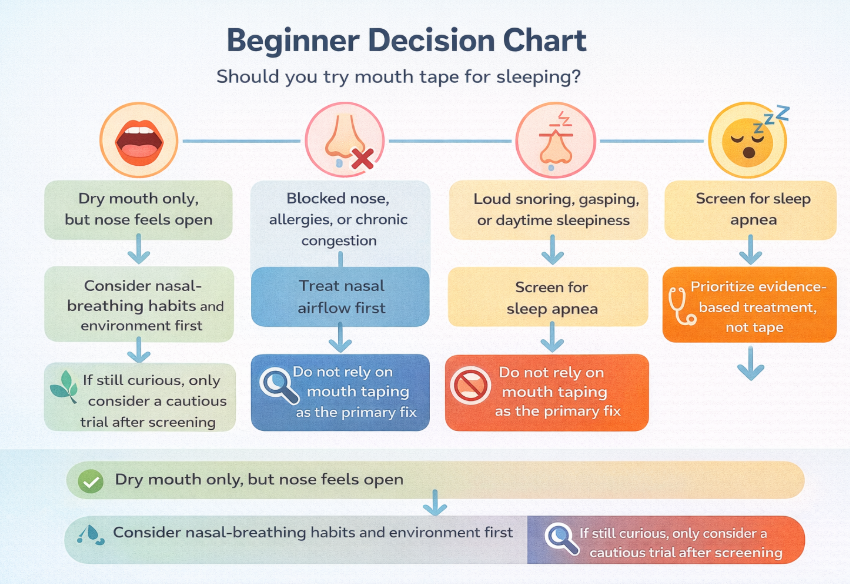
This decision path is based on current clinical cautions around nasal obstruction, the warning signs of sleep apnea, and safer alternatives for snoring or airway-related sleep problems.
Safer Alternatives and Decision Points
For many readers, the most useful section is not whether tape is trendy, but what to do instead. Cleveland Clinic recommends safer options for snoring such as sleeping on your side, using nasal strips to improve airflow, treating congestion, and using CPAP or an oral appliance when sleep apnea is present.
Better first steps for common goals
If the goal is quieter breathing, start with nasal airflow and sleep position. If the goal is less morning dryness, review nasal congestion, room air, and oral health habits. If the goal is treating diagnosed obstructive sleep apnea, evidence-based options such as CPAP or oral appliance therapy belong at the center of the plan. Oral appliance therapy is recognized by AASM and AADSM as an effective treatment option for snoring and for some patients with obstructive sleep apnea, while CPAP remains first-line therapy for OSA.
That comparison also helps readers understand where sleep mouth tape fits in the hierarchy: not as first-line care, not as a substitute for evaluation, and not as a cure-all. At best, it may play a supporting role for selected users under the right conditions.
FAQ
Q1: What is mouth tape for sleep?
A: Mouth tape for sleep is a skin-safe tape or patch placed over the lips before bed to encourage nasal breathing instead of mouth breathing during sleep.
Q2: Why do people use mouth tape?
A: People use mouth tape to support nasal breathing, reduce dry mouth, and try to improve snoring or overall sleep comfort.
Q3: Does mouth tape work?
A: Mouth tape may help some people who mainly breathe through the mouth at night, but it is not a proven solution for every sleep problem and should not replace medical evaluation.
Q4: How to put on mouth tape?
A: Use a skin-safe product designed for sensitive skin, make sure your nose feels clear before bed, and start cautiously. If breathing feels uncomfortable, stop immediately.
Q5: Is sleeping with mouth tape safe?
A: Sleeping with mouth tape is not safe for everyone. People with nasal blockage, allergies, heavy snoring, or possible sleep apnea should be cautious and seek professional advice first.
Q6: Can mouth tape cure sleep apnea?
A: No. Mouth tape is not a cure for sleep apnea and should not be used as a substitute for diagnosis or evidence-based treatment.
Conclusion
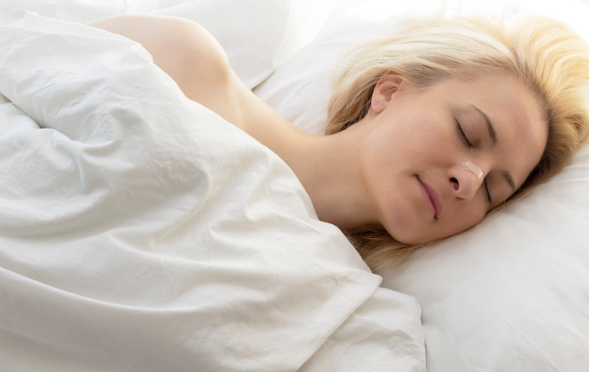
Mouth Tape for Sleeping is popular because it promises a simple answer to a messy sleep problem. The strongest part of the idea is the value of nasal breathing. The weakest part is the assumption that tape alone can solve snoring, dry mouth, or poor sleep for everyone. For a small subset of people, it may provide limited benefit. For many others, especially those with congestion, heavy snoring, or possible sleep apnea, it may be the wrong starting point, reader-helpful conclusion is clear: respect the trend, but trust screening, airway logic, and evidence more than hype.
Sections
25 June 2026
Nose strips and nasal dilators are both non-drug products used to support nasal airflow, but they work in different ways. Nose strips are usually external adhesive strips placed across the outside of the nose, while nasal dilators are often small devices placed inside the nostrils. The better choice depends on your breathing need, comfort preference, skin sensitivity, use frequency, and whether the problem is temporary or ongoing.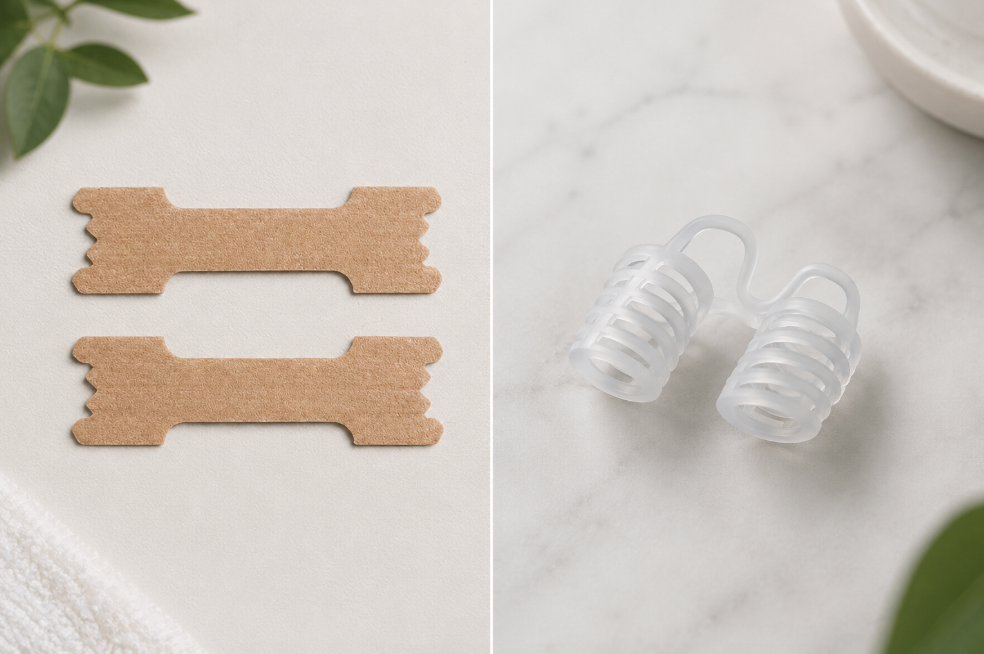 Read More