How Safe Is Mouth Tape for Sleeping?
Date:2026-04-23
Read:115
source: zoey
Abstract
This article gives a direct, evidence-aware answer to the question is mouth tape safe. The short answer is that mouth tape is not universally safe, and it is not a blanket sleep solution. A narrow group of adults with reliable nasal breathing and no signs of sleep-disordered breathing may tolerate it, but many people should avoid it. The key issue is that tape can sometimes hide or worsen an underlying problem such as nasal blockage, untreated snoring, or obstructive sleep apnea. To help readers make a cleaner decision, the article explains when risk is lower, who should not try it, what warning signs matter, and which alternatives are safer to test first.
Quick Answer
Mouth tape can be safe for some adults when used correctly, especially those with clear nasal airflow and no underlying breathing issues, but proper product selection and individual evaluation are still important to ensure comfortable and safe use.
Key Takeaways
l Mouth tape can be a safe option for many adults when used properly, especially for those with clear nasal breathing and no known breathing-related conditions.
l The best results are usually seen in people who can breathe comfortably through the nose and who choose skin-friendly, well-designed mouth tape products.
l Although current research is still developing, some studies suggest that mouth tape may help support healthier nighttime breathing habits in selected users.
l For a better and safer experience, it is important to pay attention to comfort, skin response, and overall breathing quality during use.
l When needed, combining mouth tape with supportive measures such as nasal care, allergy management, or sleep evaluation can help improve both comfort and safety.
Is Mouth Tape Safe? A Direct Answer?
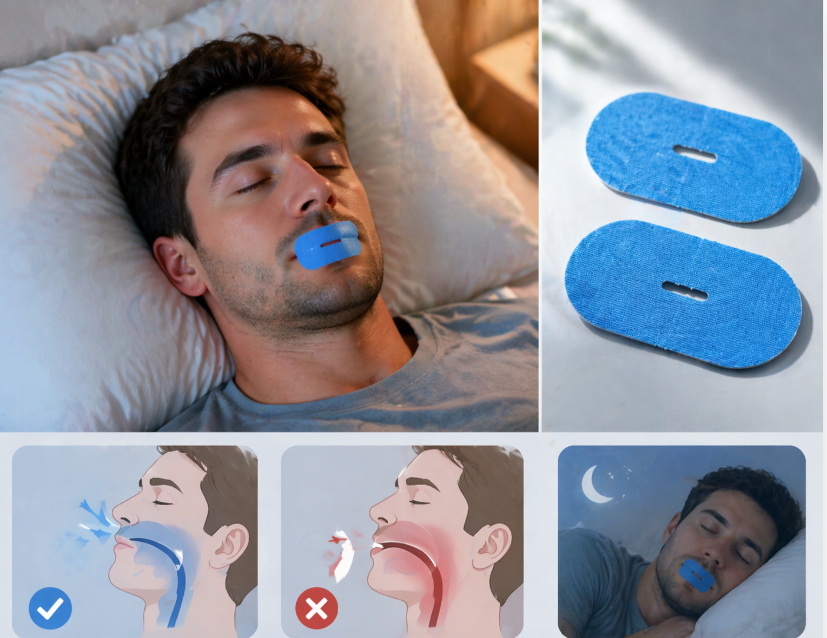
The most useful answer is this: is mouth tape safe for sleep? Sometimes, but only under limited conditions, and not as a broad recommendation for the average snorer or mouth breather. The practice is popular because the idea sounds simple. If the mouth stays closed, nasal breathing may increase, the throat may stay less dry, and some people may notice less noise at night. But the same shortcut can become risky if the nose is not reliably open or if the person is compensating for a deeper airway problem by breathing through the mouth.
That distinction matters. Mouth opening during sleep is not always the problem itself. It can be a signal. Some people sleep with an open mouth because of allergies, congestion, a deviated septum, enlarged tonsils, reflux, or undiagnosed obstructive sleep apnea. In that situation, tape does not solve the root issue. It only removes one breathing route while the underlying cause stays in place. That is why safety discussions around mouth tape should start with airflow and symptoms, not with social media before-and-after stories.
Why the evidence does not support a blanket yes?
Current research is still limited. A few small studies suggest that selected mouth breathers, including some people with mild obstructive sleep apnea, may see less snoring or better airflow control. But broader reviews also note that the evidence base is small, the study designs are heterogeneous, and many social claims go far beyond what research has actually shown. In practical terms, that means mouth tape cannot yet be treated as a broadly validated sleep fix.
Why safety depends on your reason for mouth breathing?
If you breathe through your mouth only because your lips fall open while your nose is consistently clear, risk may be lower. If you breathe through your mouth because your nose is blocked or your airway is unstable, risk rises quickly. That is why the question is sleeping with mouth tape safe should always be tied to the cause of mouth breathing, not just to the tape itself.
Safety Snapshot
Situation | Likely Safety Read | Practical Meaning |
Nose stays clear at night and there is no snoring, gasping, or known sleep disorder | Lower risk, but still not automatically recommended | Tape may be tolerated, but it is still worth testing airflow first and keeping the trial conservative |
Snoring, witnessed pauses, choking awake, morning headaches, or heavy daytime sleepiness | Higher risk | Get evaluated for sleep-disordered breathing before trying tape |
Frequent congestion, allergies, deviated septum, sinus issues, or enlarged tonsils | Often not a good candidate | Fix nasal obstruction first instead of forcing the mouth closed |
CPAP users under clinician guidance to reduce mouth leak | Case-specific | This is different from casual self-experimentation and should stay individualized |
When Is Sleeping With Mouth Tape Safe-er?
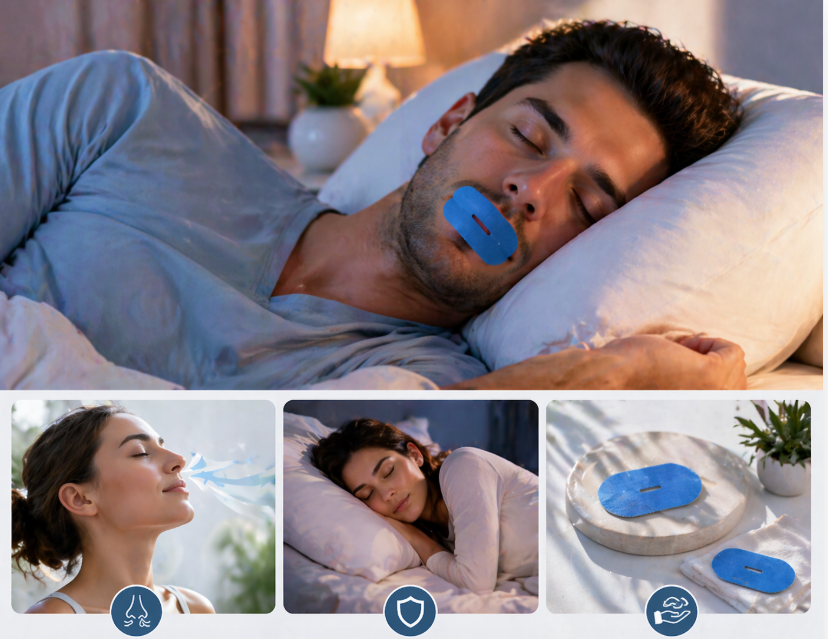
The more accurate phrase is safe-er, not safe. There are situations where the risk profile appears lower, but even then, the practice should be approached cautiously. Three conditions matter most: clear nasal breathing, absence of red-flag symptoms, and a clear understanding that tape is a behavior aid, not a treatment for airway disease.
Clear nasal breathing matters more than tape strength
A person who can breathe easily through the nose during the day and at night is in a different position from someone who alternates between clear breathing and congestion. Safety drops when airflow depends on luck, season, room dryness, or changing allergy symptoms. In other words, the question is not whether the adhesive is gentle. It is whether nasal airflow is dependable for a full night.
Lower-risk users usually have fewer warning signs
People in the lower-risk group generally do not report choking awake, loud or irregular snoring, observed pauses in breathing, severe morning dry mouth, waking headaches, or pronounced daytime sleepiness. Once those symptoms appear, mouth tape moves out of the lifestyle category and into the “get assessed first” category.
Clinician-guided use is different from trend-driven use
There is also a difference between guided adjunctive use and self-prescribed experimentation. In limited clinical contexts, some patients use mouth tape or other mouth-closing strategies to reduce CPAP mouth leak or to support a specific treatment plan. That is not the same thing as assuming tape is a safe fix for anyone who snores.
Who Should Not Try Mouth Tape for Sleeping?
People with likely airway or breathing problems
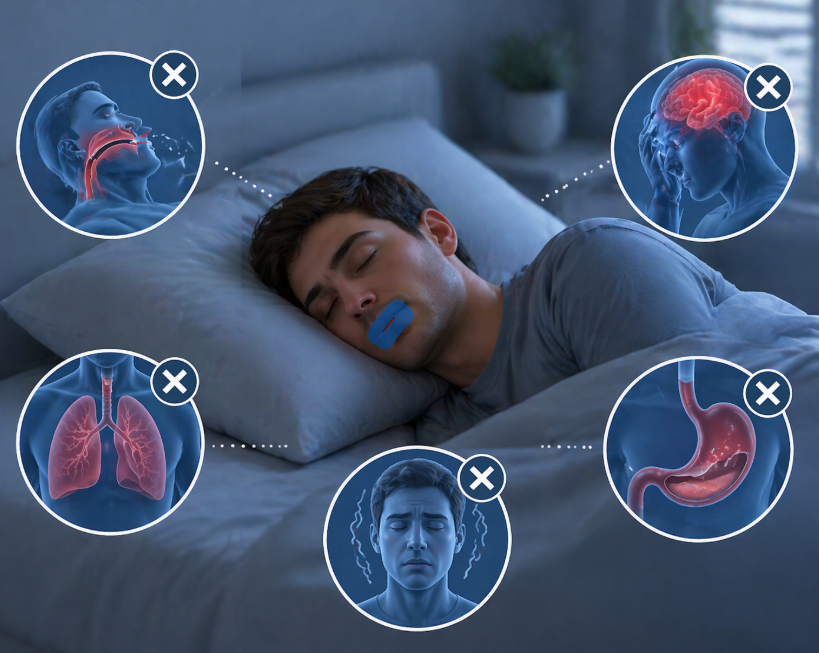
Do not treat mouth tape as a first-line answer if you have untreated snoring, suspected or diagnosed sleep apnea, frequent gasping, chronic nasal congestion, recurrent sinus issues, a deviated septum, enlarged tonsils, asthma that affects nighttime breathing, or other heart and lung conditions. In these groups, closing the mouth can increase distress rather than improve sleep.
People whose symptoms suggest the problem is bigger than dry mouth
If you wake up exhausted, if a partner notices pauses in breathing, if you get headaches on waking, or if you feel sleepy enough to struggle through the day, the real priority is diagnostic clarity. Mouth tape may delay that by making the routine feel proactive while the cause remains untreated.
People prone to panic, reflux, or abrupt nighttime congestion
Some users do not run into oxygen-related problems but still have a poor experience because the sensation of a sealed mouth triggers anxiety, fragmented sleep, or a sense of air hunger. Others may feel fine at bedtime but become congested later in the night. That unpredictability is exactly why “I felt okay when I applied it” is not a sufficient safety test.
Is Mouth Tape Dangerous? Common Risks and Misconceptions
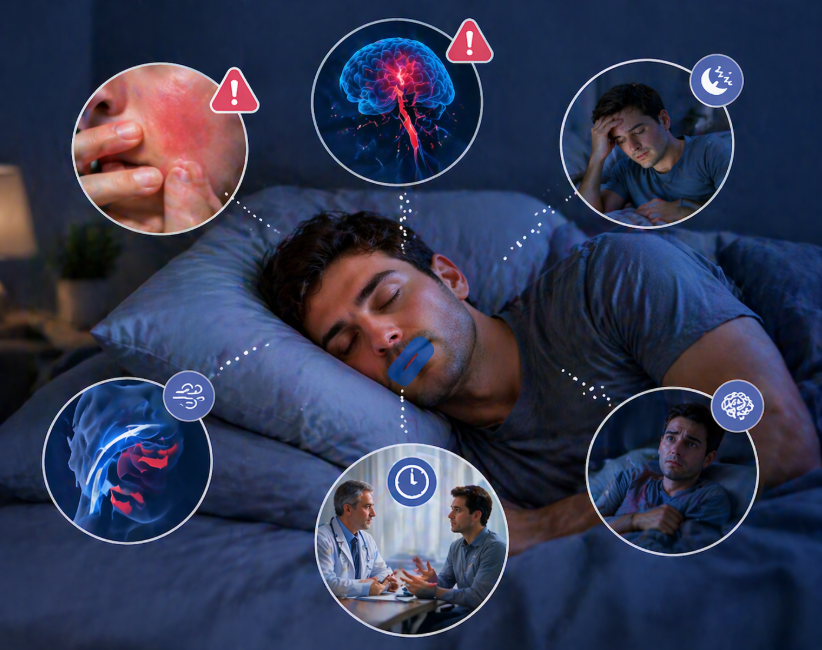
The most common mistake is assuming that danger only means a dramatic emergency. In reality, is mouth tape dangerous often comes down to smaller but still meaningful problems: skin reactions, disrupted sleep, anxiety, poor airflow, and delayed diagnosis of sleep-disordered breathing. These are not trivial if they become nightly patterns.
Skin-safe does not mean airway-safe
A product can be gentle on the lips and still be the wrong choice for breathing. Many marketing messages focus on adhesive comfort, but the real safety question is airway adequacy. Comfortable removal does not tell you whether it is wise to remove a compensatory breathing route.
Stronger hold is not better hold
Some buyers assume stronger adhesion is safer because it prevents leaks. For a sleep-safety conversation, that logic is backwards. If the tape must hold firmly to “work,” it also becomes harder to remove quickly when breathing changes, congestion appears, or anxiety spikes. The safest product design is not necessarily the strictest one.
Mouth tape does not fix the reason you sleep with your mouth open
This may be the most important misconception to correct.Mouth tape can influence behavior, but it does not treat allergic swelling, structural nasal narrowing, unstable airway tone, reflux, or sleep apnea. So even when a user reports fewer symptoms, the improvement may be partial, temporary, or context-specific.
Risk and Next-Step Comparison
Common Risk or Misread | Why It Matters | Better Next Step |
Skin irritation or lip discomfort | Reduced adherence and lower chance of consistent use | Reassess whether you need tape at all before changing adhesives |
Feeling air hunger after applying tape | Possible sign that nasal airflow is not adequate | Stop the trial and evaluate congestion or obstruction |
Snoring continues or becomes irregular | May indicate that mouth opening was not the main problem | Consider sleep evaluation rather than stronger tape |
Sleeping “better” but still tired in daytime | Symptoms may be masked while the underlying disorder persists | Track symptoms and discuss sleep testing with a clinician |
What To Do If Mouth Tape Feels Unsafe at Night?
If you wake up uncomfortable, do not “push through” to see whether the body adapts. Remove the tape, note what happened, and treat the event as useful information. Difficulty breathing through the nose, sudden congestion, panic, coughing, reflux, or repeated waking all argue against continued self-testing.
Stop immediately if airflow feels restricted
The first rule is simple: restricted breathing is a stop signal, not a training signal. If the night felt strained, interrupted, or claustrophobic, the experiment failed from a safety standpoint.
Escalate faster if red flags are present
Seek clinical input sooner if there is loud snoring, witnessed apneas, choking, reflux into the throat, new chest discomfort, or marked daytime sleepiness. These symptoms deserve evaluation whether or not you ever use tape again.
Better Alternatives When Safety Comes First
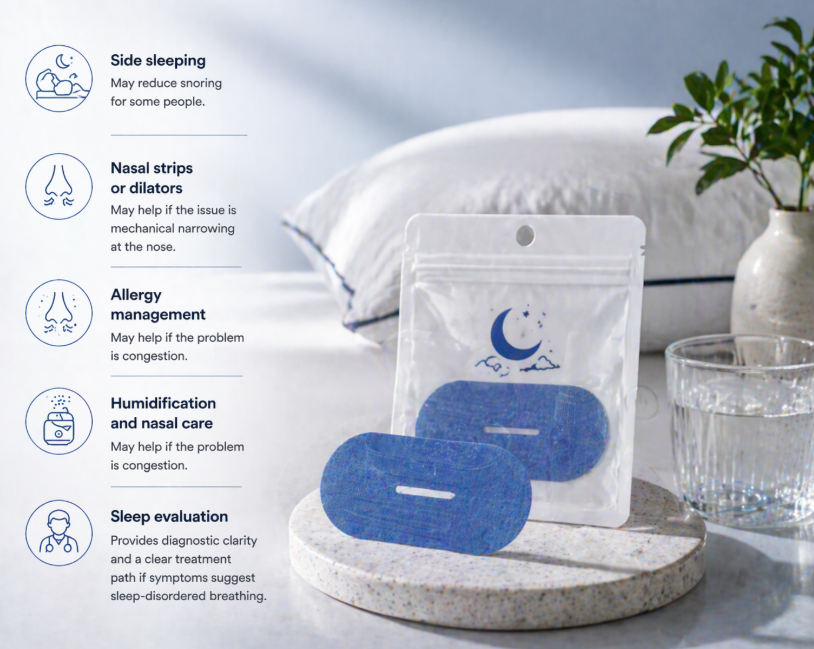
If your real goal is quieter, more comfortable sleep, safer first steps usually exist. Side sleeping may reduce snoring for some people. Nasal strips or nasal dilators may help if the issue is mechanical narrowing at the nose. Allergy management, humidification, and nasal care may help if the problem is congestion. And if symptoms suggest sleep-disordered breathing, a sleep evaluation gives you a clearer path than experimentation.
Start with the nose and airway, not the lips
A safer sequence is to ask why the mouth opens, then address that driver. If the nose is the bottleneck, forcing lip closure is the wrong first move. If the airway is collapsing during sleep, the right discussion may be about testing, oral appliances, positional therapy, or CPAP rather than about tape.
Use a decision chart instead of a trend mindset
The best way to think about this is not “Does mouth tape work?” but “What does my symptom pattern suggest?” That shift prevents people from using a broad internet trend to solve a very personal airway problem.
Decision Chart
If this sounds like you | Safer next move |
“I only notice mild mouth opening, and I breathe clearly through my nose.” | Assess nasal comfort first and be conservative rather than assuming tape is necessary. |
“I snore loudly or my partner notices breathing pauses.” | Prioritize sleep evaluation before any mouth-closing product. |
“My nose blocks often at night.” | Treat congestion or get nasal assessment instead of forcing mouth closure. |
“I use CPAP and lose air through my mouth.” | Discuss mask fit, chin strap options, or clinician-guided strategies rather than self-testing blindly. |
FAQ
1.Is sleeping with mouth tape safe?
For some adults with consistently clear nasal breathing and no signs of sleep-disordered breathing, risk may be lower. But is sleeping with mouth tape safe as a general recommendation? No. The answer is conditional, and many people should be evaluated before trying it.
2.Is mouth tape dangerous if I snore?
It can be. Snoring may be a sign that airflow is already unstable. In that setting, is mouth tape dangerous becomes a more serious question, because tape may hide symptoms or worsen the situation in someone who depends on mouth breathing as a backup route.
3.What if I mainly want help with dry mouth?
Dry mouth alone does not prove that tape is the right tool. It is better to ask why the mouth is open at night and whether the nose stays clear. A mouth-opening symptom should lead you back to the cause.
4.What should I do if I feel discomfort or panic?
Remove the tape immediately and do not keep retrying the same setup. Discomfort, panic, air hunger, or fragmented sleep are all reasons to stop and reassess.
Conclusion
So, is mouth tape safe? The most accurate conclusion is that it may be tolerated by a limited group of adults, but it is not broadly safe as a do-it-yourself sleep hack. If your nasal breathing is not reliably clear, if you snore heavily, if you suspect sleep apnea, or if the practice creates discomfort, the safer path is to stop and investigate the reason your mouth opens at night. In sleep health, a simple fix is only useful when it matches the actual problem.
Medical References
· Cleveland Clinic: Mouth Taping - Is It Safe To Use While Sleeping?
· Sleep Foundation: Mouth Taping for Sleep - Does It Work?
· SleepApnea.org: Mouth Taping for Sleep - Does It Work?
· Fangmeyer SK et al. 2025. Nocturnal mouth-taping and social media: A scoping review of the evidence
Sections
20 May 2026
Nasal strips are returning in running culture because they fit the way modern runners test small, simple, and drug-free gear upgrades. Once mostly associated with sleep, snoring, and nighttime breathing support, these external nose strips are now showing up in marathon photos, running clubs, gym bags, and social media training routines. For many runners, the appeal is not that one strip can transform performance, but that it is easy to try, visible, lightweight, and simple to add to a running routine. Read More