What Are Pimple Patches Made Of?
Date:2026-10-16
Read:73
source: Zoey
Pimple patches may look like simple stickers, but their effectiveness depends on the materials beneath the surface. From fluid-absorbing hydrocolloids to flexible backing films and specialized adhesives, each component influences how a patch protects a blemish, manages moisture, and stays attached to the skin.
Understanding what pimple patches are made of helps consumers choose suitable products and skincare brands make more informed decisions about materials, ingredients, and product development.
Quick Answer
Most pimple patches are made of hydrocolloid, a moisture-absorbing material containing gel-forming ingredients. They typically combine an absorbent adhesive layer with a flexible backing film, while some formulas include additional skincare ingredients.
Key Takeaways
Hydrocolloid is the main absorbent material in traditional pimple patches, helping manage fluid from surface-level blemishes.
Common hydrocolloid ingredients include sodium carboxymethylcellulose (CMC), pectin, and sometimes gelatin, depending on the formulation.
A typical patch combines a gel-forming adhesive layer, a protective backing film, and a removable release liner.
Medicated and microdart patches use different ingredients or delivery structures, so they should not be treated as interchangeable products.
Patch thickness, adhesive properties, flexibility, and formulation affect comfort, coverage, and overall product performance.
What Are Pimple Patches Made Of?
Most traditional pimple patches are made of hydrocolloid, a material originally developed for wound dressings. Hydrocolloids contain water-absorbing substances that interact with moisture to form a soft gel. This makes them useful for covering blemishes with visible fluid while providing a physical barrier against touching and picking.
However, hydrocolloid is not a single chemical ingredient. It describes a category of formulations that may combine gel-forming particles, adhesive components, elastomers, and a supporting film. The exact composition varies between manufacturers and product types.
For example, sodium carboxymethylcellulose is a common absorbent ingredient, while polyisobutylene may be used in the adhesive matrix. Polyurethane films are also used in some patch constructions to provide a flexible outer surface.
Common Pimple Patch Ingredients and Their Functions
| Material or ingredient | Main function | Role in the patch |
|---|---|---|
| Sodium carboxymethylcellulose (CMC) | Absorbs moisture and forms a gel | Supports fluid management |
| Pectin | Gel-forming material | Contributes to moisture absorption |
| Gelatin | Gel-forming material in some formulations | Supports the hydrocolloid matrix |
| Polyisobutylene | Adhesive and binder component | Helps maintain attachment and material cohesion |
| Polyurethane film | Flexible backing material | Provides an outer protective layer |
| Elastomers and other polymers | Adjust flexibility and mechanical properties | Help the patch conform to skin movement |
| Silicone-coated release liner | Protects the adhesive before use | Allows the patch to be removed from its packaging |
Not every pimple patch contains all these ingredients. The actual composition should be confirmed through the manufacturer's formulation or product documentation.
This distinction matters because two products labeled "hydrocolloid pimple patches" may differ in adhesion, flexibility, thickness, fluid-handling capacity, and skin feel. These differences are relevant both to daily users and to brands developing their own acne patch products.
How Is a Hydrocolloid Pimple Patch Structured?
A typical hydrocolloid pimple patch combines an absorbent adhesive layer with a flexible backing film. A removable liner protects the adhesive surface until application.
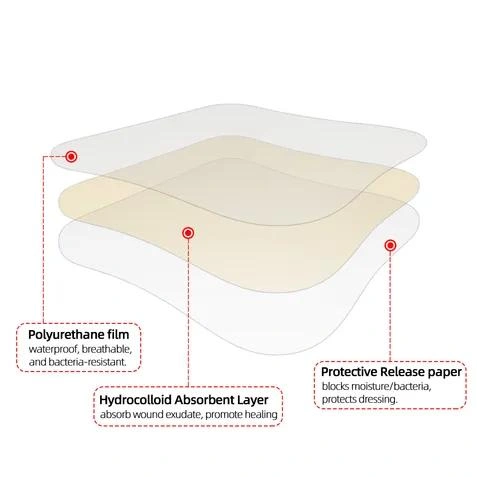
Although the patch appears to be a single piece, its construction is designed to balance moisture absorption, protection, and skin contact.
The Three Main Components of a Pimple Patch
| Component | Position | Primary purpose |
|---|---|---|
| Backing film | Outer surface | Protects the patch and supports flexibility |
| Hydrocolloid adhesive matrix | Skin-facing surface | Absorbs moisture, forms a gel, and helps the patch adhere |
| Release liner | Removed before application | Protects the adhesive during storage and handling |
The backing film and hydrocolloid matrix remain on the skin during use. The release liner is part of the supplied product but is discarded before the patch is applied.
Why the Backing Film Matters
The backing film affects how a patch looks and feels on the skin. A thin, flexible film can help a patch follow facial contours, while its moisture-vapor transmission properties influence how moisture is managed beneath the patch.
Polyurethane is one material used in hydrocolloid dressing construction, although backing materials can vary. A transparent film may also improve the appearance of a patch intended for discreet daytime use.
A thinner film is not automatically better. Manufacturers must balance flexibility and appearance with adequate strength, protective performance, and reliable handling.
Why the Adhesive Layer Matters
The skin-facing layer must do more than absorb fluid. It also needs sufficient adhesion to remain in place throughout the intended wearing period.
The formulation influences how the patch responds to facial movement, moisture, and removal. An excessively aggressive adhesive may be uncomfortable to remove, while insufficient adhesion can cause the edges to lift before the patch has completed its intended use.
The most suitable construction therefore depends on the product's intended application, rather than thickness or stickiness alone.
How Do Hydrocolloid Ingredients Work?
Hydrocolloid ingredients work through moisture absorption and gel formation. When fluid comes into contact with the absorbent components, the material takes up moisture and gradually forms a gel within the adhesive matrix.
This is why a used pimple patch may develop a swollen or whitish appearance. The visible change generally reflects moisture absorption and gel formation, although the amount of fluid absorbed varies.
For surface-level blemishes, hydrocolloid patches can help manage drainage while covering the affected area. The protective layer also discourages repeated touching or picking.
However, hydrocolloid patches are not a complete treatment for every type of acne. They generally work best when fluid is available near the skin surface. Deep, painful nodules or cysts may require a different approach, including professional dermatological care.
What Makes Hydrocolloid Suitable for Acne Patches?
Hydrocolloid combines several useful material properties:
Moisture absorption: Gel-forming components retain fluid within the patch.
Physical protection: The covering reduces direct contact with the blemish.
Adhesive attachment: The matrix helps keep the material positioned over the target area.
Flexible construction: Suitable backing and adhesive materials can follow normal facial movement.
These properties explain why hydrocolloid has become widely used in blemish patches. The material offers a localized protective solution without necessarily requiring an added acne-treatment ingredient.
Do All Pimple Patches Have the Same Ingredients?
No. Pimple patch ingredients differ depending on the intended function and product technology.
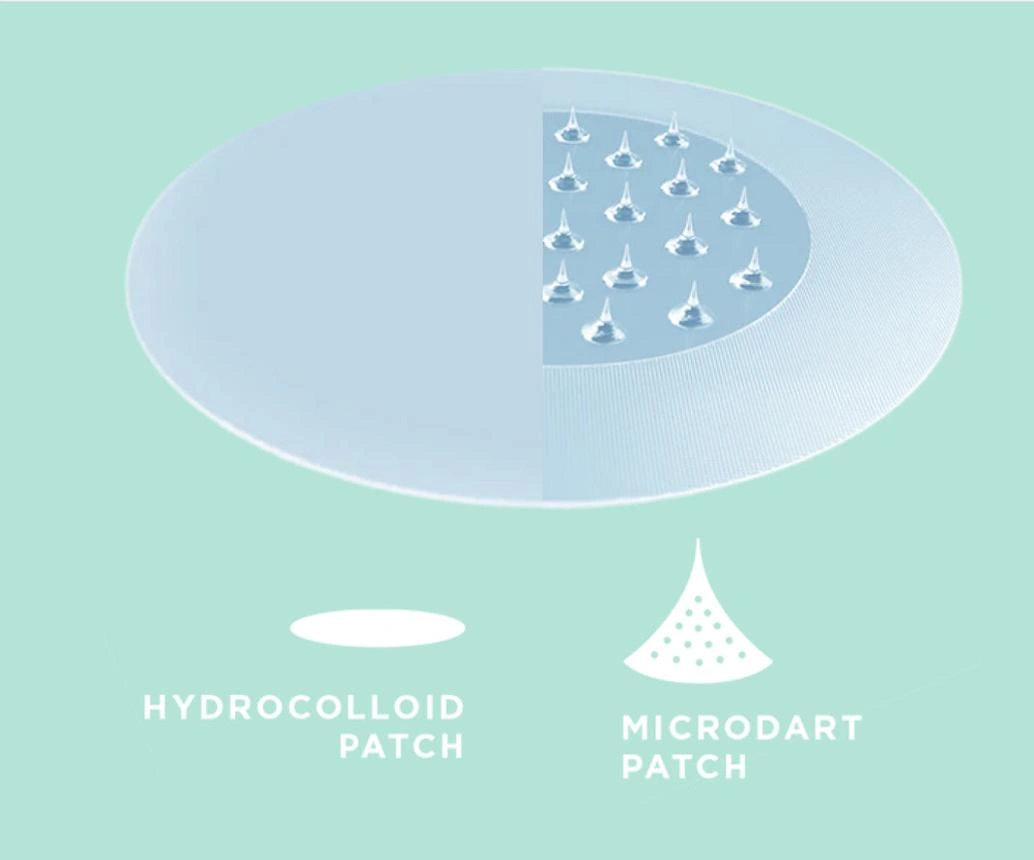
Traditional hydrocolloid patches mainly focus on moisture absorption and covering surface blemishes. Some products incorporate skincare ingredients such as salicylic acid, while microdart patches use a distinct structure designed to deliver selected ingredients through small dissolvable projections.
Understanding these differences helps avoid choosing a product based on appearance alone.
Hydrocolloid vs Medicated vs Microdart Patches
| Patch type | Main materials or components | Primary design purpose | Important distinction |
|---|---|---|---|
| Plain hydrocolloid patch | Gel-forming hydrocolloid adhesive and backing film | Absorption and protection | May contain no added acne-treatment active |
| Medicated or active-infused patch | Patch substrate with selected skincare active ingredients | Combine patch coverage with ingredient-based care | Performance depends on the active, formulation, and intended claim |
| Microdart patch | Dissolvable microneedle or microprojection structure with a supporting substrate | Localized ingredient delivery | Does not function like a conventional fluid-absorbing hydrocolloid patch |
| Decorative or shaped patch | Hydrocolloid or another specified patch material | Provide coverage with a distinctive appearance | Shape and color do not establish ingredient efficacy |
The terms "hydrocolloid," "hydrogel," and "microdart" should also not be used interchangeably. They describe different material characteristics or product technologies.
What Ingredients Are Added to Medicated Pimple Patches?
Some acne patches contain additional active or skincare ingredients. Common examples in the market include salicylic acid, niacinamide, tea tree oil, and centella asiatica-derived ingredients.
Each serves a different intended purpose. Salicylic acid is commonly associated with acne care and exfoliation, while niacinamide and centella-based ingredients are often included in formulations designed around skin appearance and soothing care.
However, adding an ingredient does not automatically make a patch more effective. Its concentration, compatibility with the patch matrix, stability, release behavior, and supporting evidence all matter.
Skincare brands should also recognize that claims about treating acne may carry regulatory requirements that depend on the product formulation and target market.
What Are Microdart Pimple Patches Made Of?
Microdart patches contain arrays of very small projections made from dissolvable or other appropriately designed materials. These projections can incorporate selected ingredients for localized delivery.
Depending on the specific product design, dissolvable microneedle materials may include hyaluronic-acid-based or other suitable polymers.
Unlike an ordinary hydrocolloid patch, the primary purpose of a microdart structure is not simply to absorb surface fluid. Its delivery behavior depends on the composition and geometry of the projections, the incorporated ingredients, and the supporting product design.
For brands interested in this category, Athena offers custom acne patch solutions that include microdart and dissolvable-material options. The exact formulation and performance requirements should be evaluated for each project.
How Do Pimple Patch Materials Affect Performance?
The ingredients used in a pimple patch influence more than its ability to absorb moisture. They also affect how the patch conforms to skin, how easily it can be applied or removed, and whether it suits daytime or overnight use.
A patch intended to be discreet under makeup, for example, may need a different thickness and edge design from a larger patch intended for overnight coverage.
This is why material selection should begin with the intended user experience rather than a single ingredient claim.
Pimple Patch Material Selection Matrix
| User or product requirement | Material consideration | What should be evaluated |
|---|---|---|
| Fluid absorption | Hydrocolloid matrix | Absorption and fluid-retention behavior |
| Discreet daytime appearance | Thin, transparent backing | Visibility, edge profile, and flexibility |
| Longer wear | Adhesive formulation | Attachment, edge lifting, and removal |
| Sensitive-skin positioning | Adhesive and ingredient selection | Irritation potential and appropriate test evidence |
| Wider blemish coverage | Flexible sheet construction | Conformability, coverage, and handling |
| Targeted ingredient delivery | Active-containing or microdart system | Ingredient compatibility and delivery evidence |
| Decorative shapes | Substrate and die-cut design | Edge quality, fit, and usable adhesive area |
These are material-selection considerations, not measured performance results for Athena products.
Does a Thicker Pimple Patch Work Better?
Not necessarily. Patch thickness can influence fluid capacity, comfort, flexibility, and appearance, but it does not determine performance on its own.
A thicker absorbent structure may provide more material for fluid retention in some designs. At the same time, extra thickness may make the patch more noticeable or less comfortable on curved facial areas.
An ultra-thin patch may be preferable for a discreet appearance, provided that its absorption and adhesive performance remain suitable for the intended use.
The best design is therefore the one that meets the intended product requirements, rather than the thickest or thinnest option.
Are All Pimple Patch Adhesives Suitable for Sensitive Skin?
No adhesive should be assumed suitable for every skin type.
Skin reactions can depend on the adhesive formulation, additional ingredients, duration of wear, and removal technique. Some users may experience irritation from adhesive contact, while others may react to added fragrance or skincare actives.
For sensitive-skin products, a simpler ingredient system may be worth considering, but fewer ingredients do not guarantee that a patch will be non-irritating.
Brands developing products for sensitive users should request appropriate material documentation and testing evidence before making claims such as "hypoallergenic" or "dermatologist tested."
How Should You Choose Pimple Patch Materials?
The right material depends on what the patch is expected to do. Consumers may prioritize comfort and suitability for their blemish type, while skincare brands must also consider product consistency, design feasibility, and packaging requirements.
For consumers, a plain hydrocolloid patch can be a reasonable starting point for a surface blemish that needs protection or moisture management. Products containing additional active ingredients require more attention to ingredient tolerability.
For brands, the selection process is more detailed. The product concept should define the target users, intended functions, appearance, and evidence needed to support marketing claims.
A Practical Material Checklist for Skincare Brands
| Development question | Why it matters |
|---|---|
| Is the product intended for daytime or overnight use? | Influences thickness, visibility, and wear expectations |
| Is fluid absorption or ingredient delivery the priority? | Determines whether hydrocolloid or another technology is appropriate |
| Does the design require transparent or colored materials? | Affects substrate selection and appearance |
| Will the patch contain additional active ingredients? | Requires compatibility, stability, and claim evaluation |
| What shapes and sizes are required? | Influences material cutting and packaging configuration |
| Which markets will the product enter? | Determines applicable labeling and regulatory review |
| What evidence will support product claims? | Helps establish realistic quality and validation requirements |
A useful evaluation should consider the finished patch rather than individual ingredients alone. Adhesion, absorption, comfort, and appearance are all properties of the complete construction.
For this reason, prototype review and relevant product testing are important parts of developing a new acne patch line.
Custom Acne Patch Materials and Solutions from Athena
Understanding patch materials is the starting point for developing a differentiated product. For skincare brands, those material choices must eventually translate into a clear product specification that can be reviewed, sampled, and prepared for manufacturing.
Athena offers OEM/ODM acne patch solutions covering hydrocolloid patches, microdart formats, material selection, and customizable product configurations.
Available development options include traditional hydrocolloid materials, high-transparency films, microneedle hydrogel, and dissolvable materials. Brands can also customize active ingredients, patch shapes, sizes, and packaging to suit different product concepts.
Material and Formulation Options
Athena's acne patch portfolio supports different product concepts, including everyday hydrocolloid care, ingredient-enhanced patches, and microdart-based solutions.
Brands can discuss ingredient options such as salicylic acid, tea tree oil, niacinamide, and centella asiatica, depending on the intended formula and development requirements.
Material and ingredient selections should be assessed together. A proposed combination needs to be checked for feasibility, stability, user suitability, and applicable product claims before commercialization.
Shape, Appearance, and Packaging Customization
Material choice also affects how an acne patch can be presented as a finished product.
Athena provides customization options for round and oval designs, localized patches, larger-area coverage, transparent appearances, set combinations, and customized packaging.
The product range includes star-shaped patches, recovery patches, extra-strength patches, and microdart formats, supporting different positioning and branding needs.
For brands, these options create opportunities to coordinate functional requirements with visual identity. However, shape and appearance should complement the patch's intended function rather than replace material and performance evaluation.
From Material Selection to a Custom Product
A practical OEM/ODM project begins with a clear product brief. Brands should identify the intended patch type, primary user needs, preferred materials, desired appearance, ingredient requirements, packaging format, and target market.
These requirements provide a basis for discussing available options and reviewing samples with the manufacturer. Specific technical specifications and test evidence should be confirmed before final product claims or commercial commitments are made.
If you are developing a private-label acne care collection, explore Athena's custom acne patch solutions to discuss suitable material, formulation, design, and packaging options for your product concept.
Frequently Asked Questions About Pimple Patch Materials
Are Pimple Patches Made of Plastic?
Not entirely. Traditional hydrocolloid patches contain a gel-forming adhesive matrix, and some use a polymer backing film such as polyurethane. The complete patch may therefore include plastic-based components, but its absorbent layer is not simply an ordinary plastic sticker.
Are Hydrocolloid Pimple Patches Vegan?
Not all of them. Some hydrocolloid formulations may contain animal-derived gelatin, while others use different gel-forming ingredients. Vegan suitability depends on the complete formulation and material sourcing. Consumers and brands should confirm this with the manufacturer rather than assuming all hydrocolloid products are vegan.
Do Pimple Patches Contain Salicylic Acid?
Some do, but plain hydrocolloid patches do not necessarily contain salicylic acid or any other acne-treatment active. Ingredient-enhanced patches are separate formulations, so the product label should be checked before use.
Are Pimple Patches Waterproof?
Some hydrocolloid patches use water-resistant outer films, but their practical water resistance depends on the finished construction and adhesive performance. A waterproof backing does not guarantee that the patch will remain attached during prolonged exposure to water, sweat, or friction.
Are Pimple Patches Biodegradable?
Not necessarily. Conventional hydrocolloid patches can contain synthetic adhesives and polymer backing films. Their environmental properties depend on the complete construction, not just whether an individual gel-forming ingredient is biodegradable. Biodegradability or compostability claims require appropriate evidence.
Can Pimple Patches Contain Fragrances or Botanical Extracts?
Yes, some formulations may include fragrances, botanical extracts, or other skincare ingredients. However, these additions can introduce compatibility and skin-tolerance considerations. Ingredient selection should reflect the intended users, product purpose, and available supporting evidence.
Final Thoughts
Most pimple patches are built around hydrocolloid materials, but their performance depends on the complete construction—from absorbent ingredients and adhesives to backing films and optional active components.
Understanding these differences helps consumers select products more thoughtfully and gives skincare brands a clearer basis for evaluating material options, product positioning, and custom development requirements.
Get Custom Acne Patches for Your Brand
Athena develops hydrocolloid, medicated and microdart acne patches for private label brands, covering material selection, formulation, shape and packaging. Contact our team to discuss materials and product configurations for your market.
Sections
14 April 2026
Mouth Tape can be a helpful overnight support product for people who tend to sleep with their mouth open, wake up with dry lips or dry mouth, or want a more comfortable way to encourage lip sealing during sleep. Read More
13 July 2026
The best nasal strips are not always the strongest, the most expensive, or the highest rated option. The right choice depends on how you plan to use them, such as for sleep, snoring, running, daily breathing comfort, sensitive skin, or temporary nasal congestion. A good nasal strip should balance lift, adhesion, comfort, and fit. Stronger adhesive may be useful for sports, while softer materials may be better for sleeping or sensitive skin. Read More