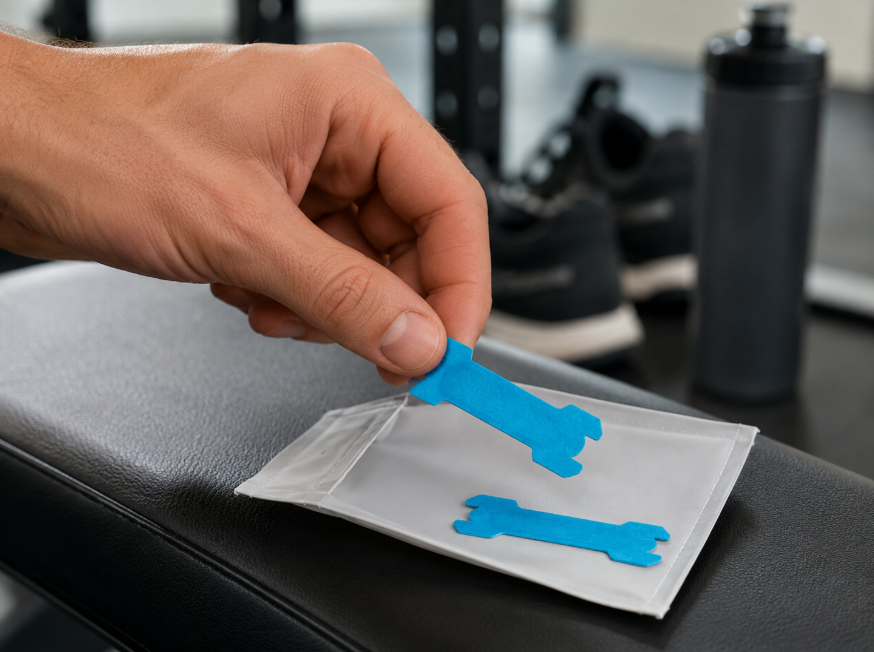
A Practical Guide to Using Nasal Strips Correctly
Date:2026-07-13
Read:507
source: Zoey
Summary
Nasal strips look simple, but placement, skin preparation, size, wear time, and removal can all affect comfort and adhesion. To use a nasal strip correctly, clean and dry the nose, position the strip horizontally across the lower bridge just above the nostril flare, and press from the center outward until both ends lie flat. The adhesive side goes against the skin.
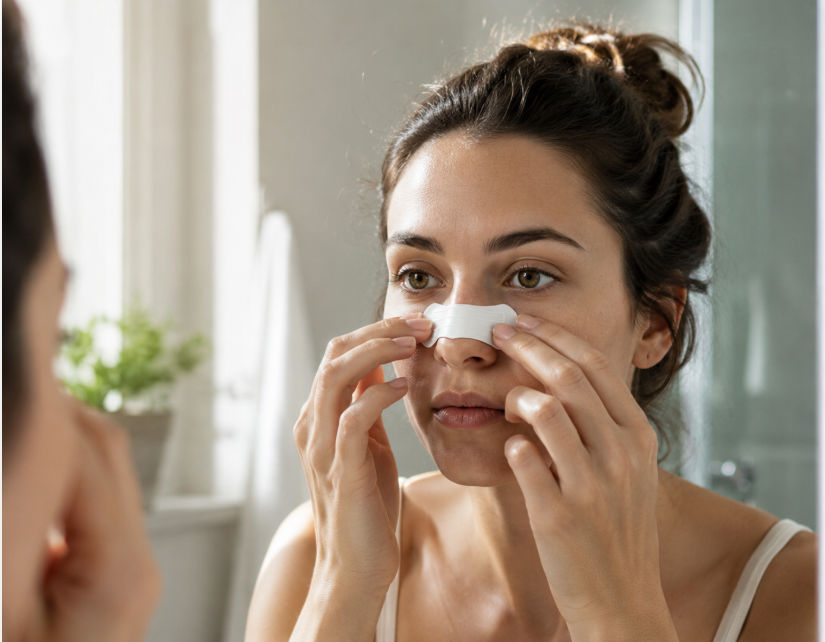
Follow the wear-time instructions supplied with the specific product, and remove the strip slowly, using warm water if needed. If a strip does not stay attached, check for skin oil, moisture, skincare residue, incorrect placement, repeated contact with the adhesive, or a size that does not match the nose.
Nose strips can be used for sleep, daily breathing comfort, running, workouts, and some nasal-airflow-related snoring situations. However, they are external support products rather than medical treatments. Persistent nasal blockage, severe snoring, choking, gasping, or suspected sleep apnea should be professionally evaluated.
For brands, distributors, and private label buyers, correct use also highlights important product-development factors. Size, shape, support structure, adhesive performance, surface material, packaging instructions, and intended use all affect whether a nasal strip is easy to apply and comfortable to wear.
Quick Answer
| Question | Practical Answer |
| How do you use nasal strips correctly? | Clean and dry the nose, place the adhesive side across the lower bridge above the nostril flare, and press from the center outward. |
| Where should a nose strip sit? | Across the lower bridge, just above where the nostrils begin to flare outward. |
| Which side goes against the skin? | The adhesive side faces the skin; the fabric, cotton, film, or printed surface faces outward. |
| What size should you choose? | Choose a strip that reaches the nasal sidewalls without pulling too tightly or extending too far onto the cheeks. |
| How long should a nose strip stay on? | Follow the approved instructions for the specific product and remove it sooner if discomfort occurs. |
| Why is the strip not sticking? | Oil, moisture, skincare residue, poor placement, repeated handling, the wrong size, or damaged packaging may reduce adhesion. |
| How should you remove it? | Loosen it with warm water if needed and peel slowly from both ends toward the center. |
| Can nasal strips reduce snoring? | They may help when snoring is related to restricted nasal airflow, but they do not address every cause of snoring. |
Where Should a Nasal Strip Be Placed?
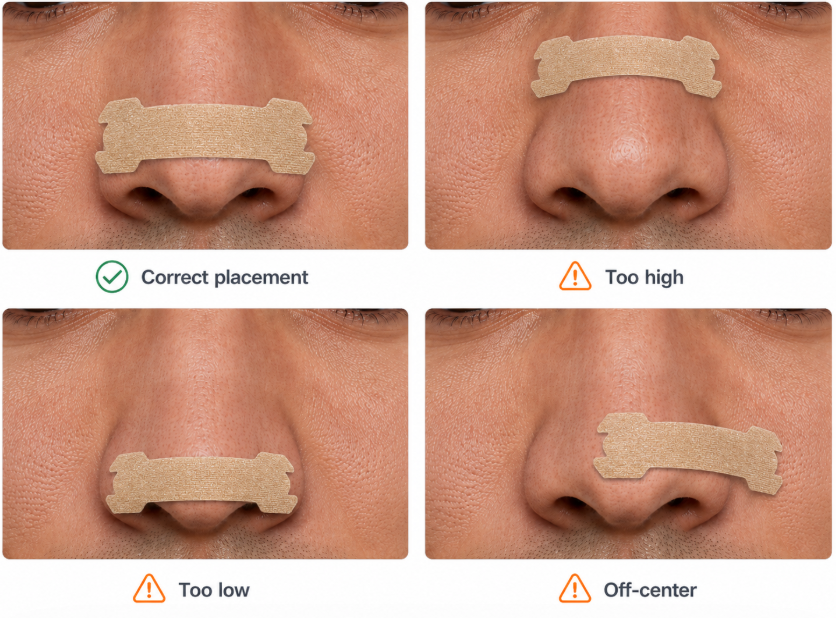
A nasal strip should sit horizontally across the lower bridge of the nose, just above where the nostrils begin to flare outward. This position allows the flexible support bands to create an outward lifting force across the nasal sidewalls.
The strip should not sit high on the hard upper bridge, directly over the nostril openings, or unevenly to one side. Incorrect placement may reduce lifting support, create uneven pulling, or cause the edges to peel away earlier.
A simple way to find the correct position is to stand in front of a mirror, identify the nostril flare, and center the strip immediately above it before pressing the adhesive firmly onto the skin.
Correct Placement
Center the strip across the lower bridge, immediately above the nostril flare. Both ends should reach the nasal sidewalls and sit at approximately the same height.
Press from the center outward, smoothing each end with a fingertip. When correctly positioned, the strip should feel secure and balanced without blocking the nostrils or pulling strongly on one side.
For a wider nose, a larger strip may provide better sidewall coverage. For a narrow nose, an oversized strip may extend too far onto the cheeks and lift at the edges.
Placement That Is Too High
A strip placed too high may sit mainly on the hard upper bridge rather than across the flexible nasal sidewalls. It may remain attached but provide little noticeable lifting support.
If the strip feels secure but does not create an even outward lift, move the position slightly lower, closer to the area immediately above the nostril flare.
Placement That Is Too Low
A strip placed too low may sit on the soft tip of the nose or too close to the nostril openings. This can feel uncomfortable, interfere with the natural movement of the nose, or make the strip easier to dislodge.
Move it slightly upward so that the center remains above the nostril flare without reaching the hard upper bridge.
Placement That Is Not Centered
An off-center strip may create stronger lift on one side and weaker support on the other. One end may also reach a more curved or oily area of the nose, increasing the chance of early peeling.
Before pressing firmly, check that the center of the strip aligns with the center of the nose and that both ends sit at approximately the same height.
If the strip has already made full contact with the skin and needs major repositioning, use a new strip rather than repeatedly removing and reapplying the same one.
What Happens If Placement Is Wrong?
Incorrect placement may reduce lifting support, create uneven pressure, cause early edge lift, or make the strip feel too tight. The most common placement errors are positioning the strip too high, too low, or off-center.
Which Side of a Nasal Strip Goes on the Skin?
The adhesive side of a nasal strip goes against the skin. The visible fabric, non-woven material, cotton, film, or printed surface faces outward.
Most adhesive nose strips are supplied on a release liner. Keep the liner in place until the nose has been cleaned and dried and you are ready to apply the product. Peel the strip away from the liner by holding its edges rather than touching the adhesive surface repeatedly.
Touching the adhesive with oily, wet, or recently moisturized fingers may reduce its holding performance. Do not apply the release liner itself to the nose.
Standard adhesive nasal strips are generally intended for single use. Once a strip has been removed from the skin, the adhesive may no longer provide the same stable hold.
How to Apply a Nasal Strip Step by Step
The following nasal strip instructions cover skin preparation, strip direction, correct placement, adhesion, fit, and removal. Always follow the instructions supplied with the specific product.Using nose strips correctly is not complicated, but each step affects how well the strip stays on.
Step 1 Clean and Dry the Skin
Wait until the skin is fully dry before opening the individual strip package. Applying a strip immediately after moisturizer, sunscreen, facial oil, or heavy skincare may reduce adhesion.Clean and dry skin helps adhesive nasal strips stay in place. Oil, sweat, makeup, moisturizer, sunscreen, and water can all reduce adhesion.
Before applying the strip:
1.Wash or wipe the nose area
2.Remove oil and skincare residue
3.Dry the skin completely
4.Avoid applying the strip right after using cream or lotion
This step is especially important before sleep, running, or workouts.
Step 2 — Check the Adhesive Side and Center Point
Remove the strip from the release liner by holding its edges. Keep the adhesive side facing the skin and avoid touching it more than necessary.
Before lowering the strip onto the nose, identify its center point and check that the flexible support bands have not been overstretched, folded, or damaged.
Do not repeatedly bend the strip before application, as this may affect its shape or make centering more difficult.
Step 3 — Position It Above the Nostril Flare
Place the center of the strip on the lower bridge of the nose, just above the nostril flare. Then gently lower both sides onto the nasal sidewalls.
The strip should feel balanced on both sides. If one side is much higher than the other, the lift may feel uneven and the edges may peel faster.
Step 4 Press from the Center Outward
Press from the center outward to secure both sides. Smooth the edges with your fingertips and hold for a few seconds.
For sleep or exercise use, make sure the edges are flat. Lifted edges are one of the most common reasons a strip comes off too early.Do not rub aggressively or repeatedly lift the ends after they have contacted the skin.
Step 5 — Check the Fit
The strip should feel secure and balanced without blocking the nostrils or creating excessive pulling. Both sides should provide a similar lifting sensation.
If one end begins to lift immediately, check whether the skin is oily or damp, whether the strip is off-center, or whether the size extends too far onto a curved part of the nose.
If the placement is clearly incorrect, use a new strip rather than repeatedly removing and reapplying the same one.
Step 6 — Remove It Gently
Remove an adhesive nose strip slowly. Do not pull it off quickly, especially if your skin is sensitive.
After use, remove the strip slowly. Warm water may help loosen the adhesive and reduce pulling. See the detailed removal section below for a complete method.
Reference: https://britishsnoring.co.uk/nasal-strips-for-snoring-guide/
How Long Should You Leave a Nasal Strip On?
Wear time should follow the instructions supplied with the specific nasal strip. Products may use different surface materials, adhesive systems, support strengths, and skin-contact specifications, so one universal wearing time should not be applied to every strip.
A sleep-focused strip may be designed for one overnight use, while a sports strip may be worn only for a training session. A daily-use strip may prioritize discreet, comfortable short-term wear. Remove the product when its approved wearing period ends, and do not reuse a standard single-use strip after removal.
Wearing a strip for longer than instructed does not necessarily create a stronger lifting effect or a better breathing experience.
When Should You Remove It Early?
Remove the strip sooner if you experience persistent itching, burning, pain, swelling, increasing redness, or excessive pulling.
The strip should also be removed if it changes position, begins to cover the nostril openings, becomes contaminated, or feels increasingly uncomfortable.
Do not continue wearing it simply because the adhesive remains attached.
Can You Leave a Nasal Strip on Longer?
Longer adhesive contact may increase discomfort for some users, especially when the skin is sensitive or when strips are applied repeatedly.
Follow the approved product instructions rather than assuming that every overnight nasal strip can remain on for the same number of hours.
Are Adhesive Nasal Strips Reusable?
Most adhesive external nasal strips are designed for single use. After removal, the adhesive may lose holding strength, collect oil or moisture, and provide less stable support.
Reusable internal or magnetic nasal dilators are different product categories and should be cleaned and used according to their own instructions.
What Size Nasal Strips Should You Use?

Size also affects placement and adhesion. A strip that is too small may not reach the nasal sidewalls, while a strip that is too large may extend onto a strongly curved area and lift at the ends.The right nasal strip size depends on nose width, nose shape, and use scenario. A strip that is too small may not provide enough support. A strip that is too large may pull the skin too much or feel uncomfortable.
For B2B brands, this is also why offering only one standard size may limit the user experience. Different markets may need regular, wide, sensitive-skin, sleep, or sports-style nose strips.
Nose Type or Use Case | Better Strip Direction |
Narrow nose | Regular or smaller nose strip |
Wider nose | Wider nasal strip with better side support |
Sleep use | Comfortable fit over maximum lift |
Sports use | Stronger edge hold and sweat resistance |
Sensitive skin | Softer material and gentle adhesive |
Signs the Strip Is Too Small
A strip may be too small if it does not reach the nasal sidewalls properly. Users may feel weak support, limited lift, or poor coverage.
A small strip may also peel because the adhesive ends do not sit in the right position. For users with a wider nose, a larger or stronger-support strip may feel more stable.
Signs the Strip Is Too Large
A strip may be too large if the ends extend too far toward the cheeks or pull the skin too tightly.
Oversized strips may cause discomfort during sleep or removal. They may also lift at the edges if the strip does not match the natural curve of the nose.
The goal is not to choose the biggest strip. The goal is to choose the best fit.
How to Use Nasal Breathing Strips for Different Scenarios
Different use scenarios need different application priorities. Sleep, daily use, sports, and snoring do not always require the same strip design.
Using Sleep Nasal Strips at Night
Sleep nasal strips should focus on comfort and stable overnight hold. Apply them before bed on clean, dry skin. Choose a strip that feels soft and secure, not overly tight.
For nighttime use, gentle removal is important because users may apply strips repeatedly. A strip that stays on but hurts to remove may not be suitable for long-term sleep use.
Using Nose Breathing Strips During the Day
Nose breathing strips for daytime use should feel light and discreet. Clear or skin-tone strips may be better for work, travel, or public settings.
Daily-use strips usually do not need the strongest adhesive. Comfort, low visibility, and clean removal may matter more than maximum lift.
Using Sports Nose Strips for Running or Workouts

Sports nose strips should be applied before sweating starts. The skin should be dry, and the strip edges should be pressed firmly.
For running, gym workouts, or training, users may prefer strips with stronger adhesion, sweat resistance, oil resistance, and secure edge hold. The goal should be nasal breathing comfort support, not guaranteed athletic performance improvement.
Using Nose Strips for Snoring
To use a nose strip for snoring, apply it before sleep on clean, dry skin. Place the adhesive side across the lower bridge just above the nostril flare, then press from the center outward until both ends lie flat.
Choose a strip designed to remain comfortable and stable during its approved overnight wearing period. A strip that is too small, too large, or poorly centered may provide uneven support or peel away early.
Nasal strips may help when snoring is associated with nasal congestion or restricted airflow through the nose. They are less likely to help when snoring originates mainly from the mouth, tongue, or throat, and they are not a treatment for obstructive sleep apnea.
Loud persistent snoring, choking, gasping, witnessed pauses in breathing, or marked daytime sleepiness should be medically evaluated.
Reference: https://britishsnoring.co.uk/nasal-strips-for-snoring-guide/
Why Is My Nasal Strip Not Sticking?
A nasal strip may fail to stick because of skin oil, moisture, skincare residue, incorrect placement, repeated contact with the adhesive, the wrong size, damaged packaging, or a product structure that does not match the use scenario.
Start by cleaning and fully drying the nose. Then check that the strip sits across the lower bridge above the nostril flare and that both ends lie on relatively smooth skin.
Oil, Moisture, or Skincare Residue
Natural skin oil, sweat, water, moisturizer, sunscreen, makeup, and facial treatments can prevent the adhesive from contacting the skin evenly.
Wash or wipe the nose, remove skincare residue, and allow the area to dry completely. Do not apply oil or cream underneath the strip.
The Strip Is Placed on a Strong Curve
If the ends extend too far onto the cheeks or another strongly curved area, they may lift early. This can happen when the strip is too large, positioned too low, or not centered.
Recheck the placement and choose a size that reaches the nasal sidewalls without extending excessively onto the surrounding skin.
The Adhesive Has Been Touched Too Much
Repeated contact transfers oil and moisture from the fingers to the adhesive. Handle the strip by its edges and apply it shortly after removing the release liner.
The Strip Was Removed and Reapplied
Standard single-use strips may lose adhesion after being lifted from the skin. If the placement is clearly incorrect, use a new strip instead of repeatedly repositioning the same one.
The Product Does Not Match the Use Scenario
A gentle daily-use strip may not stay secure during heavy sweating, while an aggressive sports adhesive may feel unsuitable for repeated overnight wear.
Match the product design to the intended scenario rather than expecting one strip to perform identically during sleep, daily use, running, and high-sweat training.
The Package or Product Has Been Compromised
Damaged pouches, unsuitable storage, excessive heat, humidity, or an expired product may affect adhesive performance.
Use a fresh strip from intact packaging and follow the recommended storage conditions. If multiple strips from the same package fail in the same way, stop using that package and check its condition.
| Problem | Likely cause | Practical fix |
| Both ends lift quickly | Oil, moisture, or skincare residue | Clean and fully dry the nose |
| One end lifts | Off-center placement | Recenter the strip and check the size |
| The strip slides after skincare | Lotion or oil underneath | Clean the application area before use |
| It no longer sticks after repositioning | Adhesive already contacted the skin | Use a new strip |
| It fails during workouts | Product not designed for sweat | Choose a sports-use construction |
| Several strips from one pack fail | Storage or packaging problem | Stop using the pack and inspect its condition |
Common Mistakes When Applying Adhesive Nasal Strips
Most application problems come from skin preparation, placement, size, handling, or removal. The detailed sections above explain how to correct each issue.
Applying on Oily or Wet Skin
Oil and moisture reduce adhesive contact. Clean and fully dry the nose before application.
Placing the Strip Too High
A strip on the hard upper bridge may not support the nasal sidewalls effectively.
Choosing the Wrong Size
A small strip may not reach the nasal sidewalls, while a large strip may extend onto curved skin and lift at the edges.
Removing It Too Quickly
Fast upward removal may increase pulling and temporary redness. Loosen the adhesive and peel slowly.
Can Nose Strips Reduce Snoring?
Nose strips may reduce snoring for some people, especially when snoring is related to nasal congestion or restricted nasal airflow. They are less likely to help when snoring comes from the throat, tongue, mouth breathing, or sleep apnea.
How to Remove a Nasal Strip Without Pulling the Skin
Do not remove a nasal strip with one fast upward pull. Slow removal reduces sudden mechanical stress on the skin and may make the process more comfortable, particularly after overnight wear.
Loosen the Adhesive with Warm Water
Wet the strip with warm water during facial cleansing or in the shower. Allow the material and adhesive to soften briefly before beginning removal.
Avoid very hot water, aggressive rubbing, or unapproved solvents on the skin.
Peel from Both Ends Toward the Center
Lift one end carefully and peel it inward while keeping the strip close to the surface of the skin. Repeat from the other side and work toward the center.
Pulling low and slowly is generally gentler than lifting the strip sharply upward.
What to Do After Removal
Wash away any remaining residue gently and allow the skin to recover before applying another strip.
Do not immediately reapply a new strip to skin that is red, broken, sunburned, painful, or irritated. Stop use if discomfort persists or worsens.
When Snoring Strips May Help
Snoring strips may be useful when users experience:
1.Nasal congestion
2.Seasonal allergies
3.Cold-related stuffiness
4.Nighttime nasal breathing discomfort
5.Mild nasal airflow restriction near the front of the nose
They are most useful when the problem is near the nasal passage rather than deeper in the airway.
When Nasal Strips May Not Be Enough
Nasal strips may not be enough for severe snoring, choking during sleep, daytime tiredness, long-term one-sided blockage, suspected sleep apnea, or structural nasal problems.
In these cases, users should not rely only on over-the-counter nose strips.
Is There a Downside to Using Nose Strips?
There can be downsides to using nose strips, especially if the product does not match the user’s skin, nose shape, or breathing issue.
Possible Skin Irritation
Adhesive nasal strips may cause redness, itching, pulling, or mild irritation in some users. They should not be applied to broken, sunburned, inflamed, or irritated skin.
If discomfort continues after removal, stop using the product and let the skin recover.
Limited Results for Some Breathing Problems
Nose strips are external support products. They may not solve severe congestion, structural nasal issues, or sleep-related breathing disorders.
Users with long-term symptoms should seek professional evaluation rather than depending only on nasal strips.
Single-Use and Adhesive Limits
Most external nasal strips are single-use products. Reusing them can reduce adhesion and may not be hygienic.
Humidity, heat, sweat, and oily skin can also affect performance. This is why product design, adhesive selection, and user instructions all matter.
How Better Nasal Strip Design Makes Correct Use Easier
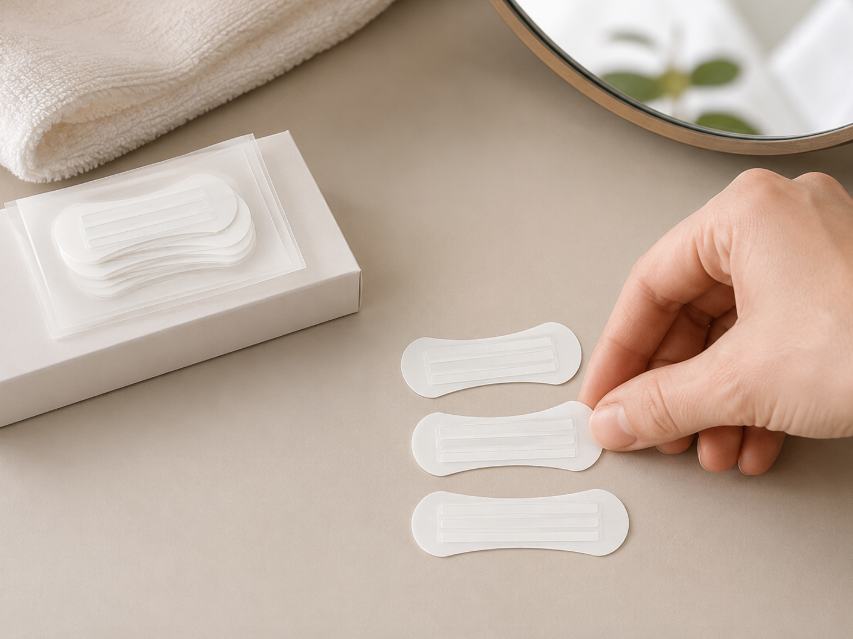
Better nasal strip design can make correct use easier. A well-designed strip should be easy to place, comfortable to wear, stable during the intended use, and gentle to remove.
For brands and distributors, this means user complaints are not always caused by incorrect use. Sometimes the product itself needs better sizing, softer material, stronger edge hold, clearer instructions, or a more suitable adhesive system.
Why Size, Shape and Adhesive Matter for Performance
Size, shape, and adhesive directly affect nose strip performance.
If the strip is too small, support may be weak. If it is too large, it may feel uncomfortable. If the adhesive is too weak, the strip may peel. If it is too strong, removal may hurt.
This is why sleep nasal strips, sports nose strips, daily-use strips, and sensitive-skin strips should not always use the same design.
How Athena Supports Custom Nasal Strips for Different Uses
Athena supports OEM/ODM custom patch solutions, helping global brands develop custom nasal strips and mouth tapes for different user scenarios.
Through end-to-end manufacturing support, Athena can help private label brands customize key product parameters, including:
1.Adhesive selection: options can be developed for sweat-resistant sports use, stable overnight wear, or gentle skin contact.
2.Material choice: product structures may include breathable non-woven fabric, flexible PE backing, cotton, PU material, or other skin-contact materials based on positioning.
3.Support structure: different strip shapes, bridge ratios, and spring-support layouts can be developed to adjust lifting feel and fit.
User scenario design: sleep nasal strips, sports nose strips, daily-use strips, and sensitive-skin options can be designed with different comfort and adhesion goals.
4.Private label packaging: brands can customize pouching, retail boxes, logo design, instructions, color, and multilingual packaging.
5.Flexible production support: Athena supports sample-based development, artwork-based design, small-batch testing, and scalable OEM/ODM production.
Brands can learn more at https://www.athenamed.cn/
FAQ About Using Nasal Strips and Nose Strips Correctly
1. How do you use nasal strips correctly?
Clean and dry the nose, place the adhesive side across the lower bridge just above the nostril flare, and press from the center outward until both ends lie flat.
2. Where should a nasal strip be placed?
Place it horizontally across the lower bridge, just above where the nostrils begin to flare. Avoid placing it on the hard upper bridge, the soft tip, or directly over the nostril openings.
3.Which side of a nasal strip goes on the skin?
The adhesive side goes against the skin. The visible fabric, cotton, film, or printed surface faces outward. Avoid touching the adhesive more than necessary after removing the release liner.
4.How long should you leave a nasal strip on?
Follow the wearing instructions supplied with the specific product. Different strips may use different materials and adhesive systems. Remove the strip sooner if it causes persistent itching, pain, burning, swelling, or increasing redness.
5.What size nasal strip should you use?
Choose a size that reaches the nasal sidewalls without pulling too tightly or extending too far onto the cheeks. Narrow and wide noses may need different dimensions, and the intended use may also affect the preferred size and support level.
6.Why is my nasal strip not sticking?
Common reasons include oil, moisture, skincare residue, incorrect placement, the wrong size, touching the adhesive repeatedly, repositioning a used strip, or damaged packaging. Clean and fully dry the nose before applying a fresh strip.
7. How do you remove a nasal strip?
Loosen the strip with warm water if needed, then peel slowly from both ends toward the center while keeping it close to the skin. Avoid removing it with one fast upward pull.
8. Can nasal strips reduce snoring?
They may help when snoring is related to restricted nasal airflow. They do not address every cause of snoring, particularly snoring related to the mouth or throat, and they are not a treatment for sleep apnea.
Conclusion
Using nasal strips correctly comes down to four basics: clean skin, correct placement, proper size, and gentle removal. These simple steps can improve comfort and help the strip stay in place.
Nose strips can be used for sleep, daily breathing comfort, running, workouts, and some nasal-based snoring situations. However, different scenarios need different product designs. Sleep strips should feel soft, sports strips should resist sweat, and daily-use strips should be discreet and easy to remove.
For brands, nasal strip performance is not only about how users apply the product. It also depends on material, shape, adhesive strength, size, structure, and packaging instructions. Athena can support brands that want to develop custom nasal strips for different markets and user needs.