Magnetic Nasal Strips vs Adhesive Strips — Which One Actually Works Better?
Date:2026-08-10
Read:245
source: Athena
Magnetic nasal strips have become a highly visible alternative to the familiar adhesive strip, especially among people looking for easier nasal breathing during sleep or exercise. Both designs aim to support the nasal valve from the outside, but they create that outward pull in different ways—and the evidence behind them is not equally mature.
Key Takeaways
- Adhesive nasal strips have the stronger published evidence base for increasing nasal patency and reducing nasal resistance in some users.
- Magnetic systems may feel stronger and reuse the bridge or band, but their skin-contact tabs are still consumable and direct comparative clinical research is limited.
- Fit, adhesive performance, skin tolerance and nasal anatomy matter more than the word “magnetic.”
- Neither option treats obstructive sleep apnea or guarantees better athletic performance.
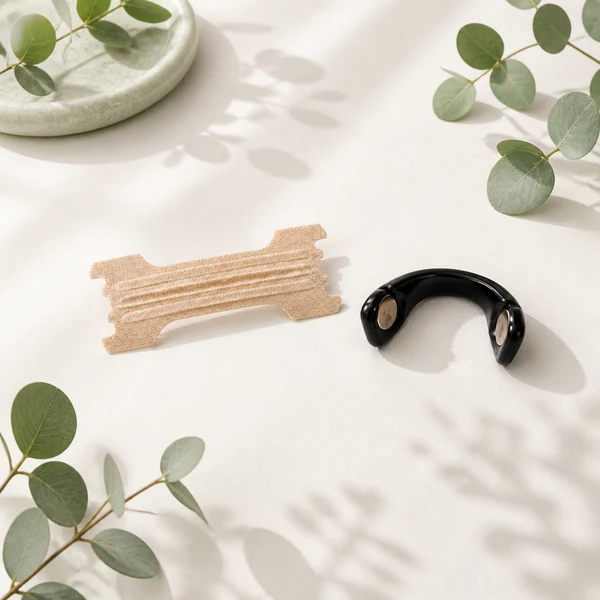
Magnetic Nasal Strips vs Adhesive Strips: Which Works Better?
For most buyers seeking a well-studied, simple and portable external nasal dilator, adhesive nasal strips are the more evidence-backed choice. Magnetic nasal strips may offer a more adjustable or pronounced lifting sensation for some people, but there is not yet enough independent head-to-head research to conclude that they work better overall.
The fairest comparison is not “magnets versus no magnets.” The magnet does not open the airway by acting on nasal tissue. In a magnetic system, small adhesive tabs sit on the sides of the nose and connect to a reusable arched band. Magnetic attraction holds the band to those tabs; the shape and tension of the band then pull the nasal walls outward. A conventional adhesive strip integrates the spring element and adhesive into one piece placed across the bridge of the nose.
Both are therefore mechanical external nasal dilators. Their practical differences lie in force distribution, placement, skin-contact area, component count, reusability and cost per use.
How Do Adhesive Nasal Strips Work?
Adhesive nasal strips use flexible ribs that try to return to their original shape after the strip is applied, gently lifting the sides of the nose and stabilizing the nasal vestibule. This can make the narrow nasal-valve region less prone to collapse during inhalation.
Published studies have measured improvements in nasal geometry, inspiratory flow or nasal resistance with external nasal dilator strips. A randomized study of nasal inspiratory flow reported that strips selectively increased maximum nasal inspiratory flow by supporting the lateral vestibular walls. Other research using acoustic rhinometry and airflow measurements has also found measurable changes in nasal patency. However, results vary by anatomy and baseline nasal resistance; a person whose obstruction is deeper in the nose may notice much less benefit.
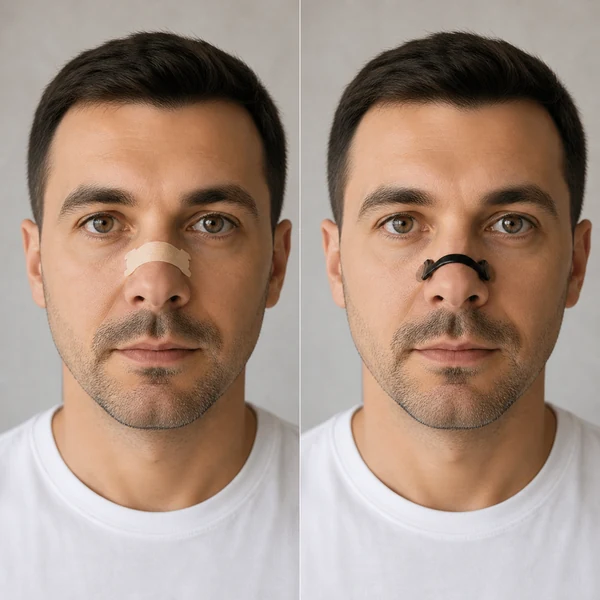
The design looks simple, yet small manufacturing choices affect performance. The stiffness and recovery force of the spring ribs determine how much lift is available. The adhesive must resist facial oil, moisture and movement without creating excessive peel force during removal. The backing needs to conform to different nose shapes without wrinkling, while the contact layer must remain comfortable over several hours. Our guide to nasal strip materials, adhesion and design explains these construction variables in more detail.
How Do Magnetic Nasal Strips Work?
A magnetic nasal strip system normally uses two disposable adhesive tabs and a reusable bridge or band. The magnets are connectors; the curved band supplies the mechanical opening force.
This modular construction can create a more targeted pull on the lower sidewalls of the nose. Users can often choose among band sizes or tensions, and the main band can be reused. That helps explain why some user reviews describe an immediate, strong opening sensation. It also explains common complaints: alignment takes practice, the tabs can lift on oily or sweaty skin, and refill tabs remain an ongoing cost. Brands comparing possible formats can review Athena’s custom nasal strip product options.
Online discussions repeatedly focus on replacement-tab price, placement consistency, overnight comfort and adhesive residue. Those are useful real-world design signals, but they are not clinical proof. Research on external nasal dilators as a broad category cannot automatically establish that every magnetic product delivers the same force, fit, skin tolerance or outcome.
Evidence, Comfort and Cost Compared
| Decision factor | Magnetic system | Adhesive strip |
|---|---|---|
| Opening mechanism | Reusable curved band connects magnetically to adhesive side tabs | Integrated flexible ribs lift the nasal sidewalls |
| Published evidence | Limited product-specific independent research | Broader body of studies on external adhesive dilators |
| Reusable parts | Band is usually reusable; tabs are consumable | Normally single use |
| Placement | More steps and alignment-sensitive | One-piece application |
| Skin contact | Two smaller adhesive zones | One wider adhesive area |
| Best fit | Users wanting adjustable band tension and willing to manage refills | Users prioritizing simplicity, portability and established mechanics |
Which Feels Stronger?
A magnetic band can feel stronger because it pulls at two defined attachment points near the nasal sidewalls. That sensation does not necessarily mean it increases airflow more for every person. A well-designed extra-strength adhesive strip may generate substantial restoring force, while a poorly fitted magnetic band may pull mainly on the skin rather than effectively stabilize the nasal valve.
Which Is Better for Sensitive Skin?
Neither category wins automatically. Magnetic systems reduce the size of the adhesive footprint but concentrate force around two tabs. Conventional strips spread load over a larger area but may irritate skin if the adhesive is too aggressive or removal is rushed. Skin preparation, wear duration, adhesive chemistry and removal technique all matter. People with damaged or actively irritated skin should pause use.
Which Costs Less Over Time?
Conventional strips usually have a lower starting cost and require no reusable hardware. Magnetic kits cost more initially and still need replacement tabs. The reusable bridge may reduce material waste per session, but the true cost depends on refill pricing, tab failure rate and how long the band lasts. “Reusable nasal strips” should therefore be read carefully: the complete system is rarely adhesive-free or indefinitely reusable.
Are Magnetic Nose Strips Better for Sleep?
They may be more comfortable or feel more effective for a particular nose, but neither magnetic nor adhesive strips should be presented as a treatment for obstructive sleep apnea.

External nasal dilators may help when nighttime breathing difficulty is related to a narrow or collapsible nasal valve, mild congestion, or increased nasal resistance. They are less likely to address obstruction farther down the upper airway. A recent systematic review and meta-analysis of nasal dilators in sleep-disordered breathing did not find convincing improvements in core severity measures such as the apnea-hypopnea index. The sleeping application range shows how product requirements differ for overnight comfort. Loud habitual snoring, witnessed pauses in breathing, choking during sleep or marked daytime sleepiness warrants medical assessment rather than product experimentation alone.
Magnetic products also require an additional safety check. Because they contain magnets, users with pacemakers, implantable cardioverter-defibrillators or other magnet-sensitive medical devices should follow the product warning and consult the device manufacturer or clinician before use.
Are Adhesive or Magnetic Strips Better for Sports?
Choose based on secure fit and perceived breathing comfort—not on promises of improved endurance. A systematic review and meta-analysis of external nasal strips in sports found no significant improvement in VO2max, heart rate or perceived exertion in healthy participants.

For training, sweat resistance and movement stability become decisive. A magnetic system has multiple interfaces: skin to adhesive tab, tab to magnetic connector and connector to band. An adhesive sports strip has one bonded assembly, but its larger surface can also loosen if the skin was not cleaned and dried. Products intended for sports breathing applications should be tested under high humidity, sebum exposure, repeated facial movement and removal after perspiration—not just static peel strength in a dry laboratory.
How to Choose the Right Nasal Strip Design
Start with the location of the breathing limitation, then compare fit, force, skin compatibility and use conditions. Pull gently outward on the cheek beside each nostril. If airflow immediately feels easier, external nasal-valve support may be worth trying. This informal check is not a diagnosis, but it can indicate whether a mechanical dilator is relevant.
Choose a conventional adhesive strip if you want fast one-piece application, easy travel storage and a format supported by a larger research base. Consider a magnetic system if you value a reusable bridge, want a more adjustable pulling sensation and are comfortable with alignment and refill tabs. Readers considering other mechanical formats can also compare nose strips and nasal dilators. Whichever design you test, change only one variable at a time and assess comfort, overnight retention, skin condition and subjective airflow over several uses.
Avoid assuming that maximum pull is always best. Excessive force can feel distracting, deform the skin or create localized stress without improving the part of the airway that is actually restricted.
What Product Developers Should Evaluate Beyond the Trend
For brands, the winning format is the one that delivers repeatable nasal-wall support while remaining comfortable, manufacturable and reliable in the intended use environment.
A robust development program should define the target user and use case before choosing the mechanism. Sleep products need quiet comfort, low-profile edges and dependable multi-hour adhesion. Sports nasal strips need sweat resistance, dynamic retention and breathable materials. Sensitive-skin positioning requires evidence from material selection and tolerability testing, not simply a softer-looking backing.
Key engineering variables include spring or band restoring force, tab geometry, adhesive coat weight, backing extensibility, edge lift, placement tolerance and removal behavior. Packaging must also protect the adhesive and make correct positioning easy. These are areas where an experienced development partner can help translate a concept into testable specifications.
Athena supports brands developing breathing and sleep-support products with material selection, structural development, adhesive matching, shape customization and application-focused sampling. The goal is to turn a defined use case into measurable material, structure and wear-performance requirements before scaling production.
Frequently Asked Questions
Do magnetic nasal strips work without adhesive?
Most external magnetic systems still require adhesive tabs on the nose. The reusable band connects to those tabs magnetically, so “magnetic” does not mean adhesive-free.
Can magnetic nasal strips stop snoring?
They may reduce snoring for some people when nasal resistance contributes to the sound, but results vary and they do not treat every cause of snoring. Persistent or severe symptoms should be medically evaluated.
Can I reuse an adhesive nasal strip?
Conventional strips are designed for single use. Reapplication usually produces less reliable adhesion and may change the lifting force or hygiene profile.
Which type is better for a deviated septum?
Either may improve the feeling of airflow if external nasal-valve collapse is also present, but neither straightens a deviated septum. An ENT assessment is appropriate when obstruction is persistent or mostly one-sided.
The Bottom Line
Adhesive nasal strips currently have the clearer evidence base and the simplest use pattern. Magnetic nasal strips offer an interesting modular design and may provide a stronger or more adjustable sensation for some users, but they are not automatically more effective, fully reusable or clinically superior. The best choice is the one that matches the user’s anatomy, skin, activity and tolerance—and delivers consistent mechanical support without exaggerated medical or performance claims.
Sections
24 June 2026
Gym nose strips matter for workouts because gym training creates movement, sweat, heat, and breathing pressure that ordinary casual-use strips may not handle well. In a gym environment, users may move quickly between cardio machines, weight training, HIIT circuits, stretching areas, and recovery zones. A nose strip used in this setting needs to feel stable, comfortable, and practical during different workout stages. Read More
20 July 2026
When you wear nasal strips, the first thing that happens is not deep inside the airway. It starts on the surface of the nose. The adhesive holds the strip on the skin, while the flexible support layer creates a light outward pull on the sides of the nose. For some users, this can make the front nasal passage feel more open soon after application. For others, the difference may feel small. Some users may notice peeling edges, tightness, red marks, or adhesive residue after removal. This article explains what actually happens when nasal strips are worn, why the experience feels different from person to person, and what these reactions mean for brands developing custom nasal strips. Read More